
Introduction
In previous topics, we looked at how equations can implicitly define curves and how conics are structured. Now, we will learn how to represent these curves parametrically.
In Unit 4.1, we learned that parametric equations allow us to express both and as functions of a third variable, usually (time) or (angle), which gives us the ability to describe not just the shape of a curve, but also the direction and speed at which it is traced. Now, let’s connect this to the implicitly defined functions we covered in Unit 4.5 and 4.6.
Parametrizing Implicitly Defined Functions
An implicitly defined function is an equation involving and where is not necessarily isolated. A parametrization for such a function consists of two equations:
some function of
some function of
For these to be a valid parametrization, substituting and back into the original equation must satisfy that equation for every value of in the given domain.
Parametrizing Standard Functions
If you have a function where is already isolated (), parametrizing it is straightforward. We simply let be the “driver”:
Set
Set
Similarly, if an equation is solved for (), we let be the “driver”:
Set
Set
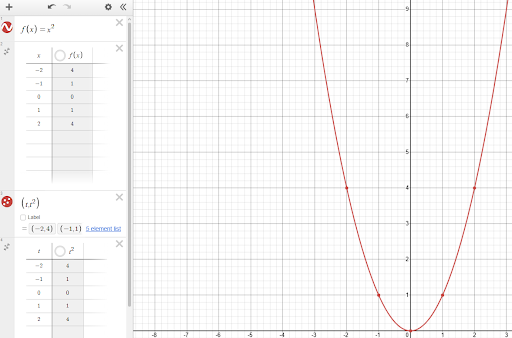
Figure 4.7.1: A diagram showing a graph of and its parametrization, made by Zachary Newcomer using Desmos.
Inverses and Orientation
If a function is invertible, we can parametrize its inverse by simply swapping the roles of :
This swapping of and effectively reflects the curve over the line , which is the geometric definition of an inverse.
Parametrizing Conic Sections
While we can parametrize parabolas using the “driver” method from above, circles, ellipses, and hyperbolas require trigonometric functions to account for their closed loops or asymptotic behavior
A. Parabolas (Linear-Quadratic)
Since a parabola is essentially a quadratic function of either or , we use substitution:
Vertical Parabola ( is a function of ):
Horizontal Parabola ( is a function of ):
B. Ellipses and Circles (Sine and Cosine)
An ellipse with center , horizontal radius , and vertical radius is defined by:
To satisfy this equation using trigonometry (remember that !), we use:
Since the sine and cosine functions complete one full cycle as varies from to , choosing as our interval traces the entire ellipse (or circle) exactly once.
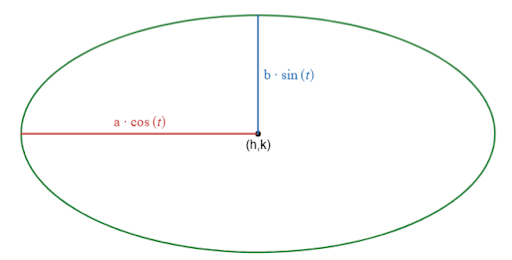
Figure 4.7.2: An ellipse with a center with a labeled horizontal and vertical radius, made by Zachary Newcomer using Desmos.
Special Case: Circles
A circle is simply a type of ellipse whose horizontal and vertical radii are equal. If we let , where is the radius of the circle, then the ellipse equation becomes , which is the standard equation of a circle centered at with radius . Substituting into the ellipse parametrization gives , . Since both coordinates are scaled by the same distance , every point generated by the parametrization is exactly units from the center, producing a circle instead of an ellipse.
C. Hyperbolas (Secant and Tangent)
Hyperbolas use the identity . The variable associated with the positive term in the hyperbola equation gets the function.
Horizontal Hyperbola (Opens Left\Right):
Parametrization:
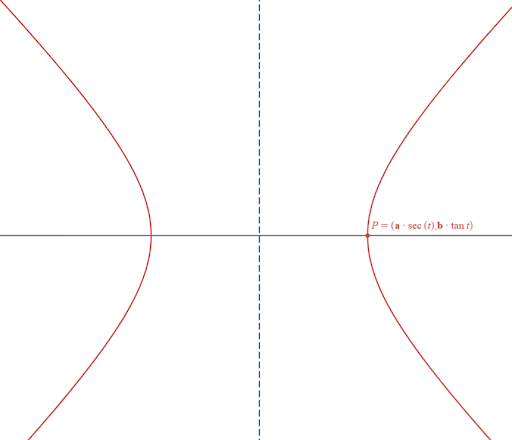
Figure 4.7.3: A horizontal hyperbola, made by Zachary Newcomer using Desmos. Note that the positive term of the hyperbola contains the expression.
Vertical Hyperbola (Opens Up/Down):
Parametrization:
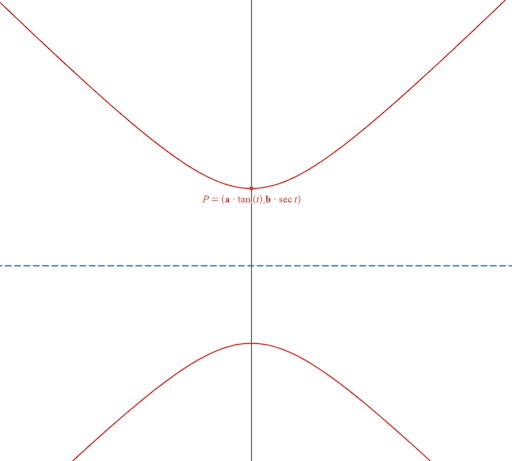
Figure 4.7.4: A vertical hyperbola, made by Zachary Newcomer using Desmos.