
Introduction
Welcome to Unit 4.8 of AP Precalculus! In this article, we will take a look at vectors, how they work, and how they connect to other topics that you've learned throughout the year. Even though it's not on the AP exam, 4.8 is still one of the largest topics in the course, so there's quite a bit to cover. Let's get started!
What is a Vector?
A Vector is a quantity that has both a magnitude and direction. In the Cartesian Plane, we represent vectors with directed line segments and describe them using their components. In this unit, we will perform operations with vectors and connect them to triangles using trigonometry.
A vector has two important points: the tail, the point where the vector begins, and the head, where the vector ends.
The direction of the vector is shown by the arrow pointing from the tail toward the head.
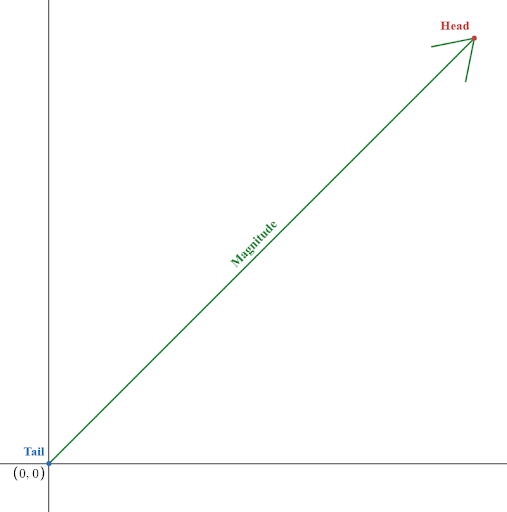
The length of the line segment represents the magnitude. Magnitude describes the length of a vector and is always a nonnegative value.
For example, if a vector begins at and ends a t, the vector can be written as .
The arrow above the points indicates that the vector starts at and ends at .
A vector can also be moved without changing its value. For example, a vector pointing units up and units to the right represents the same vector regardless of where it is placed on the coordinate plane. What matters is the direction and magnitude, not its location.
What is the difference between Vector and Scalar quantities?
We defined a vector as something that contains both a magnitude and direction. A scalar quantity only has a magnitude.
For example:
Nikolas is driving at a speed of .
The magnitude in this example is . Since only the magnitude is given, this is a scalar quantity.
To make this a vector, we must specify the direction:
Nikolas is driving east at a speed of .
Now we know both the magnitude () and the direction (east), making this a vector quantity.
Your turn!
Components of a Vector
Although vectors can be represented as directed line segments, it is often more useful to describe them using their components.
The components of a vector describe how far the vector moves horizontally and vertically.
For a vector in the plane, we write its components as , where a represents the horizontal change and b represents the vertical change.
The first component tells us how far to move in the -direction, and the second component tells us how far to move in the -direction.
Suppose we have a vector that begins at and ends at .
To find the components of the vector, subtract coordinates of the tail from the coordinates of the head:
.
The horizontal component here is , and the vertical component is .
Here what this might look like as a problem:
Find the components of the vector from to .
Using the formula , substitute the coordinates:
Simplify:.
This means that the vector moves units to the right and units upward:
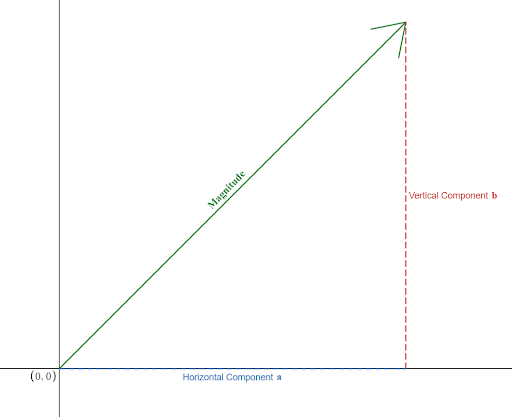
A vector with components can be placed anywhere on the coordinate plane without changing its value. The components only describe the change in position, not the location where the vector is drawn.
For this reason, vectors are often moved so that their tail begins at the origin. This makes their components easier to visualize and calculate.
A special case occurs when is the vector. This is called the zero vector. Its magnitude is , and because its initial and terminal points coincide (), it has no defined direction.
Coordinate Spaces
Before further studying vectors, we need to introduce the idea of sets and the notation used to describe them.
A set is a collection of objects. These objects can be numbers, symbols, words, or other mathematical objects.
Sets are denoted by curly brackets (braces), with each element inside being separated by a comma.
For example, {} is a set containing the numbers , , and , while {} is a set containing the colors red, blue, and green.
When we want to say that an object belongs to a set, we use the symbol , which is read as “is an element of.”
For example:
{} means that is an element of the set {}.
One important set in mathematics is the set of all real numbers, represented by .
This double-struck (or “blackboard bold”) R represents the collection of all real numbers (see Figure 4.8.3). Real numbers include every value that can be placed on a number line, such as

When we say that , this means: “ belongs to the set of all real numbers” and therefore will not contain values such as or .
This notation extends to higher dimensions as well. If we have , we are referring to the set of all ordered pairs (see Figure 4.8.4), where and are part of .
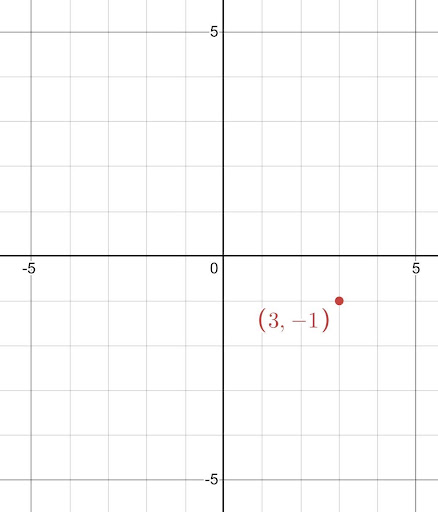
For example:
Similarly, (see Figure 4.8.5) represents the set of all ordered triples , where .
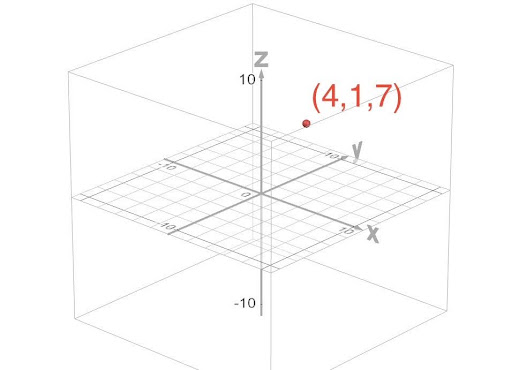
So, as shown in Figure 4.8.5, a point such as is a part of .
More generally, represents the set of all ordered -tuples of real numbers. Although we cannot visualize spaces beyond three dimensions, we can still study them using algebra.
Throughout the remainder of Unit 4, all vectors will belong to .
Be Careful!
The superscript in does not mean exponentiation. It represents the number of coordinates required to describe each point.
Magnitude of a Vector
Recall that the magnitude of a vector is its length. If a vector is represented by the components , then its magnitude is denoted by .
To find the magnitude of a vector, imagine placing its tail at the origin. The head of the vector will then lie at the point .
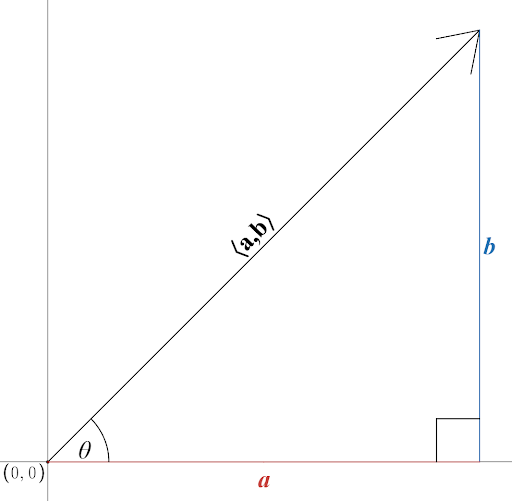
Notice that the horizontal and vertical components form the legs of a right triangle. Since we know the lengths of the legs are and , we can use the Pythagorean Theorem to find the length of the hypotenuse.
Recall that , where is the length of the hypotenuse.
In this case, the hypotenuse is the magnitude of the vector. Therefore,
.
Taking the square root of both sides gives the magnitude formula:
Here's an example:
Find the magnitude of the vector
Using the magnitude formula,
Therefore, the vector has a magnitude of .
Try it Yourself!
Direction of a Vector
Knowing the magnitude of a vector tells us how long it is, but it does not tell us which way it points. To completely describe a vector, we also need to know its direction.
The direction of a vector is measured by the angle, usually denoted by or , between the positive -axis and the vector.
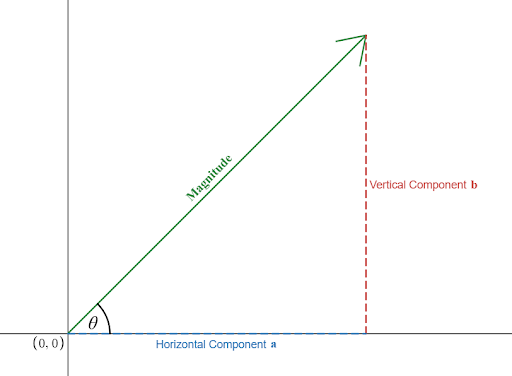
From the right triangle, we know that
.
To solve for the angle, apply the inverse tangent function:
This gives the direction of the vector.
For example:
Find the direction of the vector .
Using the formula , we get
Using a calculator, this results in .
Therefore, the vector makes an angle of approximately with the positive -axis.
Be Careful!
The formula does not always give the correct direction. This is because the inverse tangent function only returns values between and .
If the vector lies in Quadrant or Quadrant , you need to adjust the angle so that it points in the correct direction.
Some graphing calculators have a function called atan2, which automatically determines the correct quadrant. If your calculator does not, make sure to sketch the vector to verify your answer.
Example:
Find the direction of the vector .
First,
.
However, this vector lies in Quadrant , so this angle is incorrect.
Adding gives .
Therefore, the direction of this vector is .
Finding Components Using Trigonometry
In the previous section, we used the components of a vector to determine its direction. We can also work in reverse.
Suppose we know a vector’s magnitude, denoted by , and its direction, denoted by . Our goal is to determine the vector’s horizontal and vertical components.
Recall the definitions of sine and cosine:
In our triangle, the hypotenuse is the magnitude of the vector, which we’ll call . The adjacent side is the horizontal component, and the opposite side is the vertical component.
Using cosine,
, so
Using sine,
, so
Therefore, if a vector has a magnitude and direction , its components are .
Example 1
Find the components of a vector with magnitude and direction . Using the component formula,
Therefore, the vector is .
Example 2
Find the components of a vector with magnitude and direction .
Using the formula:
Therefore, the vector is .
Look out!
Notice that both components are negative as the vector lies in Quadrant .
Your Turn!
Scalar Multiplication
A scalar is a real number that can be used to multiply a vector.
When a vector is multiplied by a scalar, each component of that vector is multiplied by that scalar.
If and is a scalar, then
.
In other words, multiply each component by the scalar.
Example 1
Let .
Find .
Multiply each component by :
.
The new vector is .
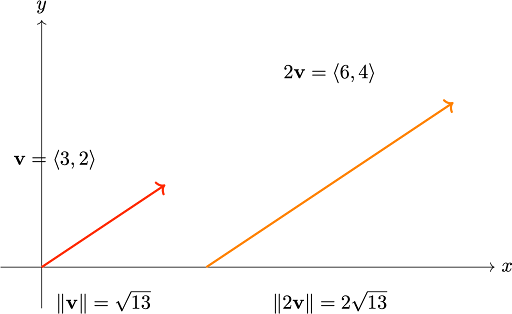
Notice that multiplying by a number greater than stretches the vector while keeping the same direction.
Example 2
Using the same vector, , find .
Multiply each component by .
Therefore, the new vector is
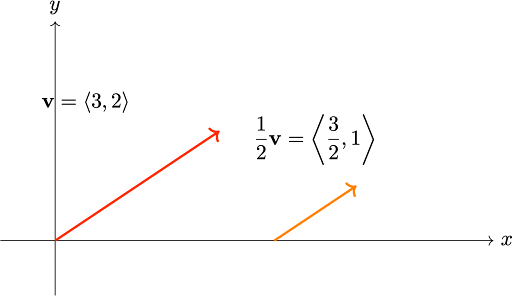
Multiplying by a number between and shrinks the vector while keeping the same direction.
Example 3
Find .
Multiply each component by :
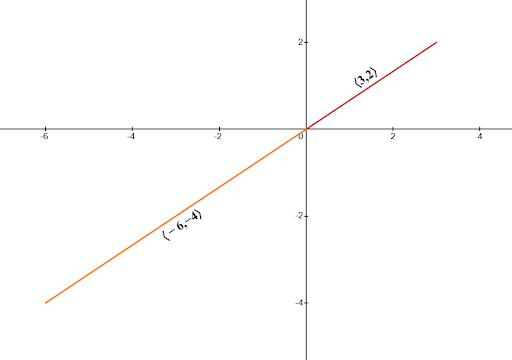
Notice that multiplying by a negative scalar reverses the direction of the vector.
Summary
If :
- The vector becomes longer by a factor of .
- The direction does not change.
If :
- The vector becomes shorter by a factor of .
- The direction does not change.
If :
- The vector changes direction.
- The magnitude is multiplied by .
Vector Addition
Just as we can add real numbers, we can also add vectors.
If two vectors are written in component form, we add them by adding their corresponding components.
If
and
,
then
.
In other words, add the horizontal components together and add the vertical components together.
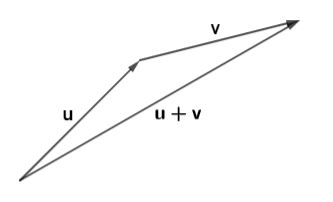
The Head-to-Tail Method
(also known as the Tail-to-Tip Method)
Vector addition can also be represented graphically.
To add two vectors graphically:
- Draw the first vector.
- Move the second vector so that its tail begins at the head of the first vector.
- Draw a new vector from the tail of the first vector to the head of the second vector.
This new vector is called the resultant vector, and it represents the sum of the two vectors.
Note that moving a vector does not change its magnitude or direction. Only its position changes.
Dot Product
So far, we have added, subtracted, and scaled vectors. We can also multiply two vectors together using an operation called the dot product.
Unlike vector addition or scalar multiplication, the dot product of two vectors produces a scalar value, not another vector.
The dot product is written using a dot (what a surprise!):
.
If , and , then their dot product is found by multiplying their corresponding components and adding the results:
Example 1
Given and :
Commutative Property
The order of the vectors does not matter:
.
Perpendicular Vectors
The dot product can also tell whether two vectors are perpendicular.
If ,
then the two vectors are perpendicular (represented by the symbol ).
For example:
and
,
Then the dot product is
Since the dot product is , .
The geometric explanation for this relationship will be explained later.
Unit Vectors
A unit vector is a vector with a magnitude of exactly 1.
In other words, if is a unit vector, then .
Unit vectors are useful because they allow us to describe only the direction of a vector without changing its orientation.
Finding a Unit Vector
To find a unit vector in the same direction as a nonzero vector, divide the vector by its magnitude.
If is a vector, then the unit vector in the same direction is .
This process is called normalizing a vector.
Unit Vectors in the Coordinate Directions
In , we have two important unit vectors:
and .
Alternatively, you may see the unit vectors written as and .
The vector points in the positive -direction, and points in the positive -direction.
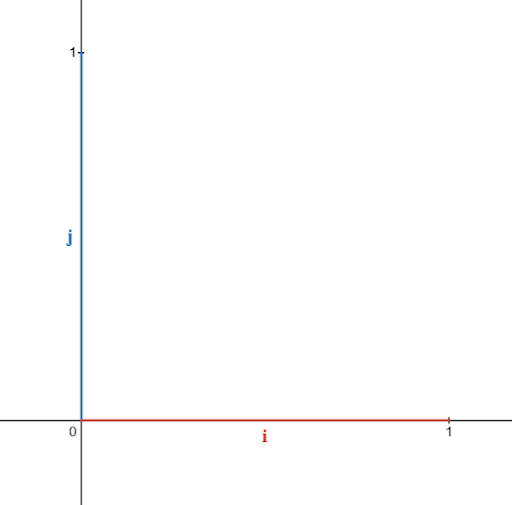
Any vector in can be written using these two unit vectors.
For example:
can be rewritten as .
This is because and .
Adding them gives:
Why are unit vectors useful?
Unit vectors allow us to separate a vector into independent horizontal and vertical directions.
Instead of viewing a vector as one object , we can view it as two simpler movements, .
Geometric Dot Product
Previously, we calculated the dot product of two vectors using their components: .
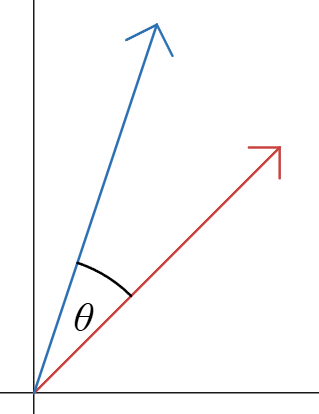
However, the dot product can also be understood geometrically using the magnitude of the vectors and the angle between them.
For two nonzero vectors, the dot product is: , where is the magnitude of vector , is the magnitude of vector , and is the angle between the two vectors.
How is Cosine Related to This?
The value of determines the sign and size of the dot product.
Vectors Pointing in the Same Direction
If two vectors point in the same direction, , and .
So, the dot product becomes .
The dot product is positive and is as large as possible.
Perpendicular Vectors
If two vectors are perpendicular, , and . Therefore, .
This gives us an important rule: .
Two nonzero vectors with a dot product of zero are perpendicular.
Vectors Pointing in Opposite Directions
If two vectors are pointing in opposite directions, , and .
Therefore,
The dot product is negative.
Finding the Angle Between Two Vectors
The geometric dot product formula can also be rearranged to find the angle between two vectors.
Starting with , divide both sides by . This gives .
Taking the inverse cosine gives us
Law of Sines/Cosines Applications
As we discussed earlier, two vectors being added together can be represented by a head-to-tail diagram.
Let’s take another look at Figure 11:
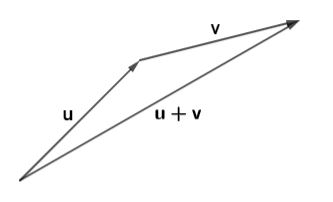
As shown, these three vectors form a triangle.
, where is our resultant vector.
Because this creates a triangle, we can use the Law of Sines and Law of Cosines to solve problems involving vector addition.
Law of Cosines
The Law of Cosines relates the side lengths of a triangle to the angle between two sides.
For a triangle with sides , , and :
, where is the angle opposite side .
This allows us to find the magnitude of the resultant vector.
Finding the Magnitude of the Resultant
Suppose two vectors have magnitudes and , with an angle between them.
The magnitude of their sum is .
You may have noticed that the term changed from a negative to a positive here. Why is this?
When using the triangle formed by vector addition,
Since , this becomes .
Law of Sines
The Law of Sines relates the sides of a triangle to their opposite angles.
This is useful when we know one side and angle pair and need to find another angle or side.
Finding the Direction of the Resultant
After finding the magnitude of a resultant vector, we may also want to find its direction. The Law of Sines helps to determine the missing angles.
After using the Law of Cosines to find the magnitude (the length) of the resultant vector , we often need to know the angle it makes with one of the original vectors. This angle gives us the vector’s direction.If is the angle between the resultant vector and the first vector , we can use the Law of Sines:
.
By rearranging this, we can solve for :
Example
Two vectors, and , have magnitudes of and , respectively. The angle between them is . Find the magnitude and direction of the resultant vector .
Using the Law of Cosines formula from earlier:
To find the direction, we use the Law of Sines.
If we let be the angle the resultant makes with the vector of magnitude , the interior angle of our triangle is .
So, the resultant vector has a magnitude of 11.36 and a direction of relative to vector .
Summary
As shown, these three vectors form a triangle.
, where is our resultant vector.
Because this creates a triangle, we can use the Law of Sines and Law of Cosines to solve problems involving vector addition.
Use the Law of Cosines when:
- You know two sides and the included angle.
- You need the magnitude of a resultant vector
Use the Law of Sines when:
- You know a side-angle pair.
- You need another angle or side length.