
What is a Vector-Valued Function?
So far in this unit, we have learned that the position of an object can be tracked by separating its horizontal and vertical movements into two functions and . In Unit 4.9, we will expand on this by using Vector-Valued Functions. Instead of looking at two separate equations, we will combine them into a single vector that will “point” to the object’s location or describe its motion at any given moment.
The Position Vector
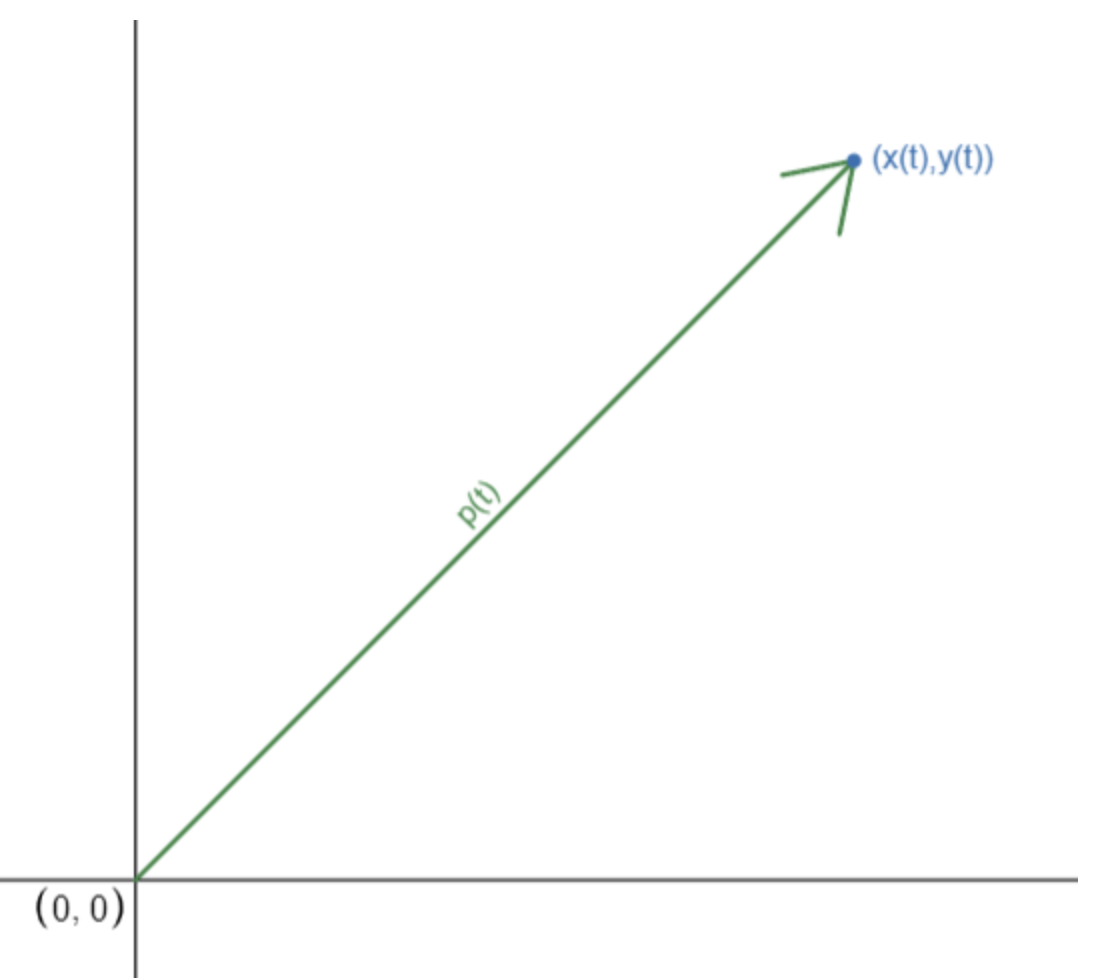
The most fundamental vector-valued function is the position vector, usually denoted as . While a parametric coordinate pair simply tells us where a particle is, the position vector is a vector that starts at the origin and terminates at the particle’s location.
Notation
There are two main ways to write a vector-valued function for position:
- Component Form:
- Unit Vector Form:
Both describe the same position: at time , the particle is located units horizontally, and units vertically from the origin.
Distance from the Origin
One special property of the position vector is that its magnitude has a physical meaning. Since the vector starts at the origin, the magnitude represents the direct linear distance between the particle and the origin at time .
Distance from origin=
The Velocity Vector and Speed
While the position vector tells us where an object is, the velocity vector, , tells us how it is moving. The components of the velocity vector represent the rates of change of the position components.
Components of Velocity
If is the position, then the velocity vector is:
,
where is the horizontal velocity and is the vertical velocity.
Direction of Motion
The signs of the components in tell us the particle’s direction at any instant:
Horizontal (-component):
- If , the particle is moving to the right.
-If , the particle is moving to the left.
-If , the particle has no horizontal velocity at that instant.
Vertical (-component):
If , the particle is moving up.
If , the particle is moving down.
If , the particle has no vertical velocity at that instant.
Speed vs. Velocity
In physics and mathematics, velocity is a vector, but speed is a scalar. The speed of a particle is the magnitude of the velocity vector.
Speed=
Planar Motion
To fully describe the motion of a particle, we must be able to analyze these vectors.
Example (Constant Velocity Motion)
Suppose a particle starts at and moves with a constant velocity vector .
This means that:
- Every second, the particle moves units right and unit down.
- Its position vector would be .
- Its speed is constant: units per second.
Example 2 (Circular Motion)
Suppose a particle moves along a circle of radius with position vector .
This means that:
The particle is always units away from the origin, meaning it moves along a circle of radius 5 centered at the origin:
Suppose that it is found that the velocity vector for this motion is .
Then, . This particle is moving at a constant speed, even though its direction is constantly changing.
Summary of Vector Relationships