
Introduction
Welcome to our AP Biology Pedigree Guide! Pedigrees are a significant tool for this course and often show up on the exam, meaning you need to be comfortable reading and understanding pedigrees. This guide will give an overview of pedigrees, their significance, and their structure, discuss the main types of pedigrees, and provide tips and tricks to identify the patterns shown in these pedigrees.
Pedigrees: An Overview, Their Significance, and Their Structure
As discussed in Topic 5.3 of AP Biology, pedigrees map the inheritance of traits and genetic diseases in families. Pedigrees are used to determine if an inheritance pattern exists within a family. In AP Biology, there are three categories of inheritance patterns: autosomal, sex-linked, and non-nuclear inheritance.
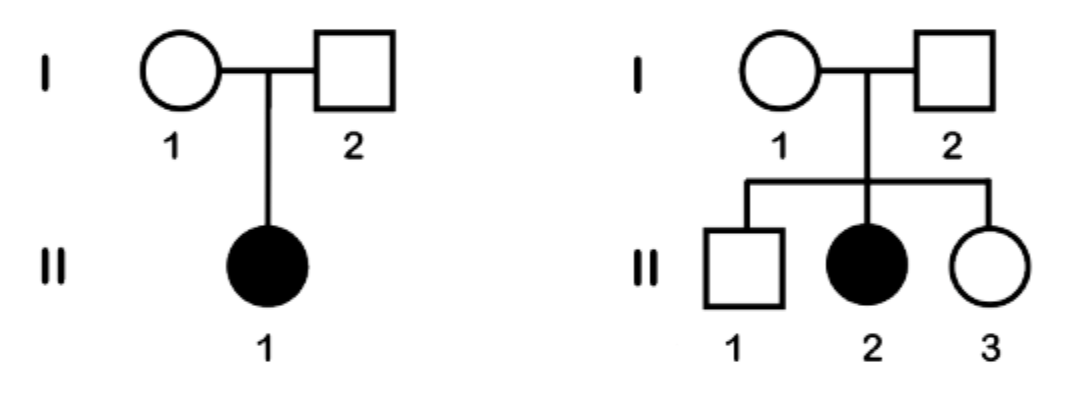
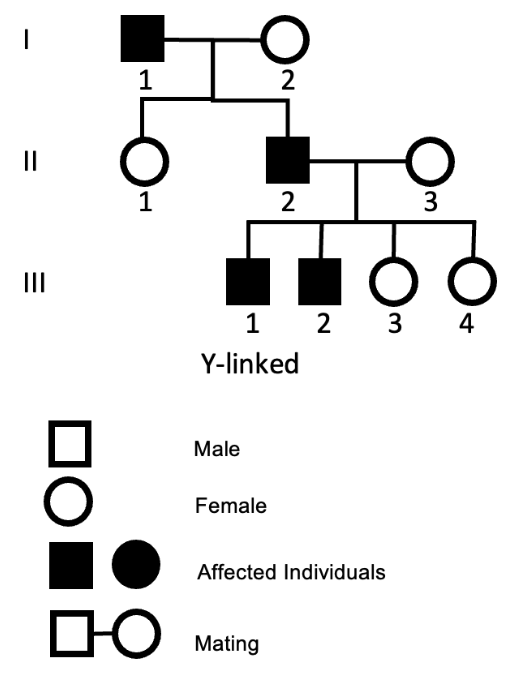
Pedigree is quite similar to that of a family tree, but there are a few key differences. Generations are marked with Roman numerals (I represents the first generation, II represents the second generation, etc.). In a pedigree, pictures and names aren’t shown; squares represent males while circles represent females. Affected males or females have the shapes they represent filled with a dark color (shaded), while unaffected males or females have the shapes they represent empty (unshaded). To name individuals on a pedigree, [generation number in terms of Roman numerals] - [individual number]. For example, a potential individual could be II-2. Below is an example of what two possible pedigrees look like. Mini-exercise: identify II-2 in the picture below.
Autosomal Inheritance
As discussed in previous articles, autosomal chromosomes are non-sex chromosomes. Autosomal inheritance is when traits are inherited through these non-sex chromosomes. The two patterns of autosomal inheritance are autosomal dominant and autosomal recessive patterns.
Autosomal Dominant
Autosomal dominant inheritance patterns don’t tend to skip generations when inherited because the presence of a dominant allele overshadows the recessive allele. If this allele is present, the trait will be present as well.
For example, if we cross a parent who’s homozygous for brown eyes, the dominant eye color, and a homozygous recessive parent (blue eyes), 100% of their offspring will have brown eyes because the dominant allele coding for brown eyes is guaranteed to be present when passed down, even if offspring also inherit the gene coding for blue eyes.
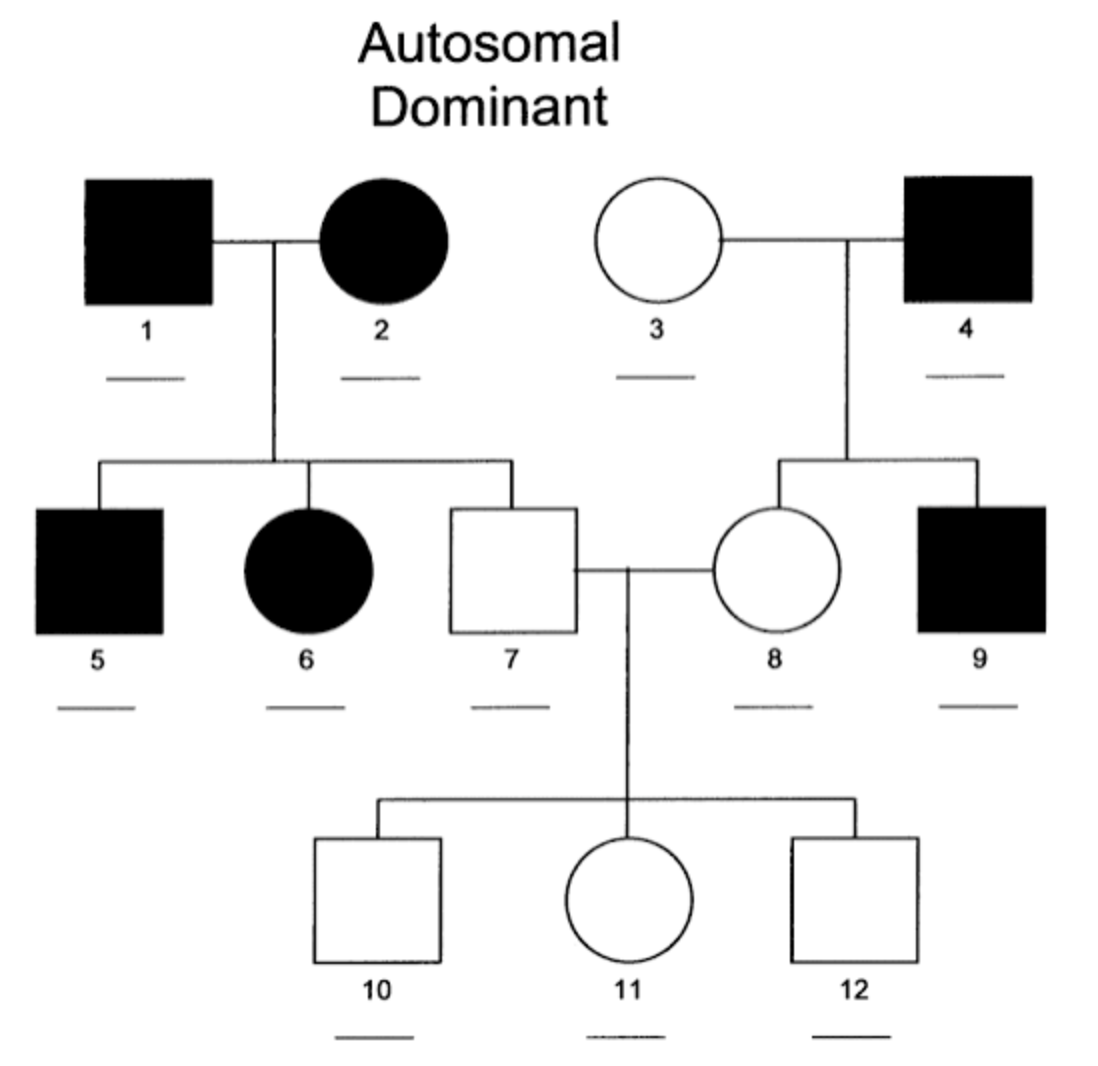
You can spot an autosomal dominant inheritance pattern in a pedigree if the traits presence doesn’t skip generations! While this isn’t a guaranteed indicator, it can help narrow down options.
Some classic examples of genetic traits or diseases that have an autosomal dominant mode of inheritance are Huntington's disease and Marfan syndrome. Below is an example of a pedigree depicting an autosomal dominant mode of inheritance:
Autosomal Recessive
Unlike autosomal dominant, autosomal recessive inheritance patterns can skip generations in pedigrees because the presence of a dominant allele overshadows them.
For example, it’s possible for two brown-eyed parents to have an offspring with blue eyes! If two parents, both heterozygous for eye color, meaning they carry both the dominant allele for brown eyes and the recessive allele for blue eyes, 25% of their offspring will inherit two recessive alleles and no dominant alleles, meaning that their eyes would be blue, and the other 75% of offspring who inherit the dominant allele would have brown eyes (use a Punnett square if you don’t believe us!).
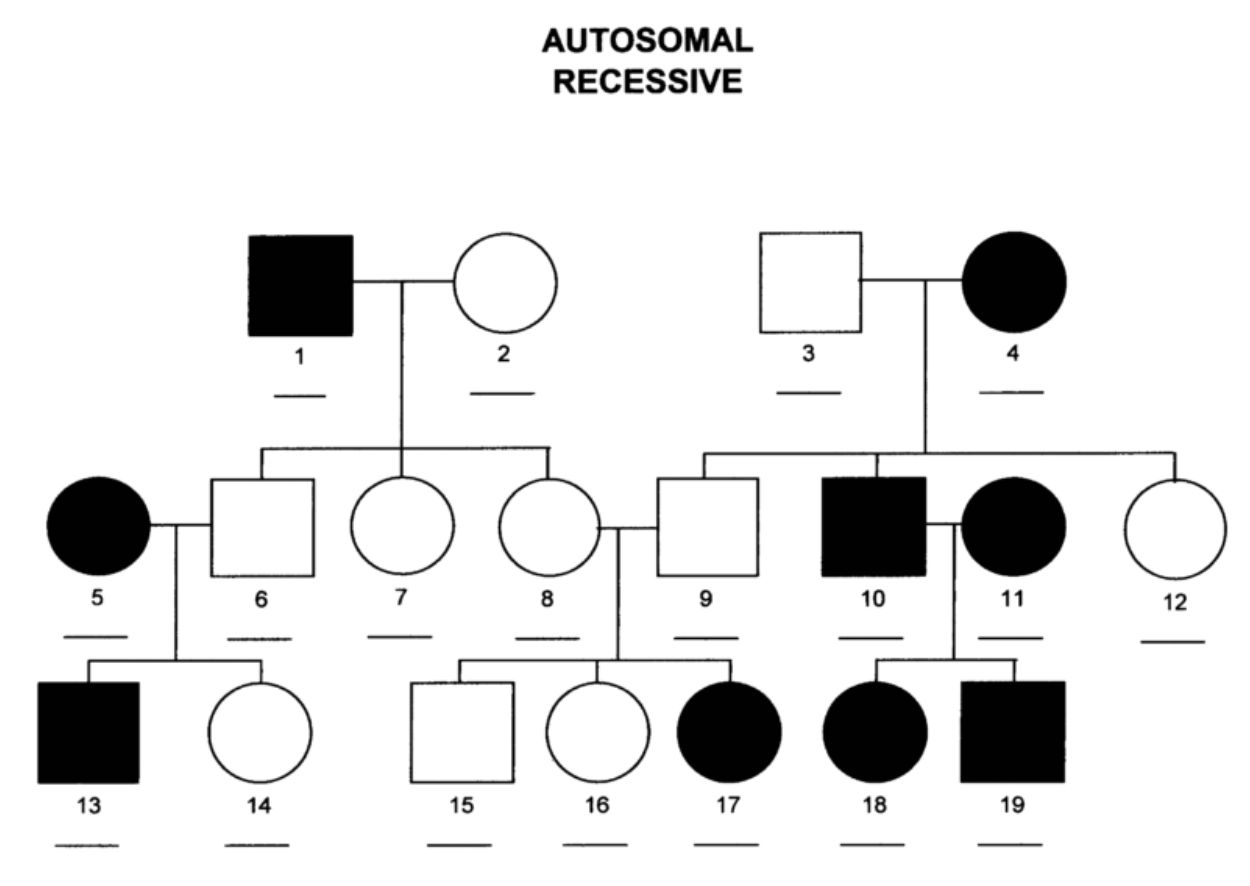
You can spot an autosomal recessive inheritance pattern in a pedigree if the trait's presence skips generations. While this isn’t a guaranteed indicator, it can help narrow down options.
Some classic examples of genetic traits or diseases that have an autosomal linked recessive mode of inheritance are cystic fibrosis and sickle cell anemia. Below is an example of a pedigree depicting an autosomal recessive mode of inheritance:
Sex-Linked Inheritance
Unlike autosomal inheritance, sex-linked inheritance is when traits are inherited from the X or Y (sex) chromosomes. The three patterns of sex-linked inheritance are x-linked dominant, x-linked recessive, and y-linked. Females can either be homozygous or heterozygous for a genetic trait/disease, while males are hemizygous for a genetic trait/disease.
X-Linked Dominant
X-linked dominant is a mode of inheritance in which the inherited trait comes from a gene on one of the X chromosomes. Just like dominant alleles, one X chromosome that a descendant inherits must be dominant for the descendant to express the inherited trait. Because females have XX sex chromosomes, they are more likely to express the trait/disease since they have 2 chances to obtain the dominant X chromosome. On the other hand, males are less likely to express the trait/disease since they have only one chance to obtain the dominant X chromosome (males have XY sex chromosomes). However, this does not mean that it is impossible for more males to be affected than females.
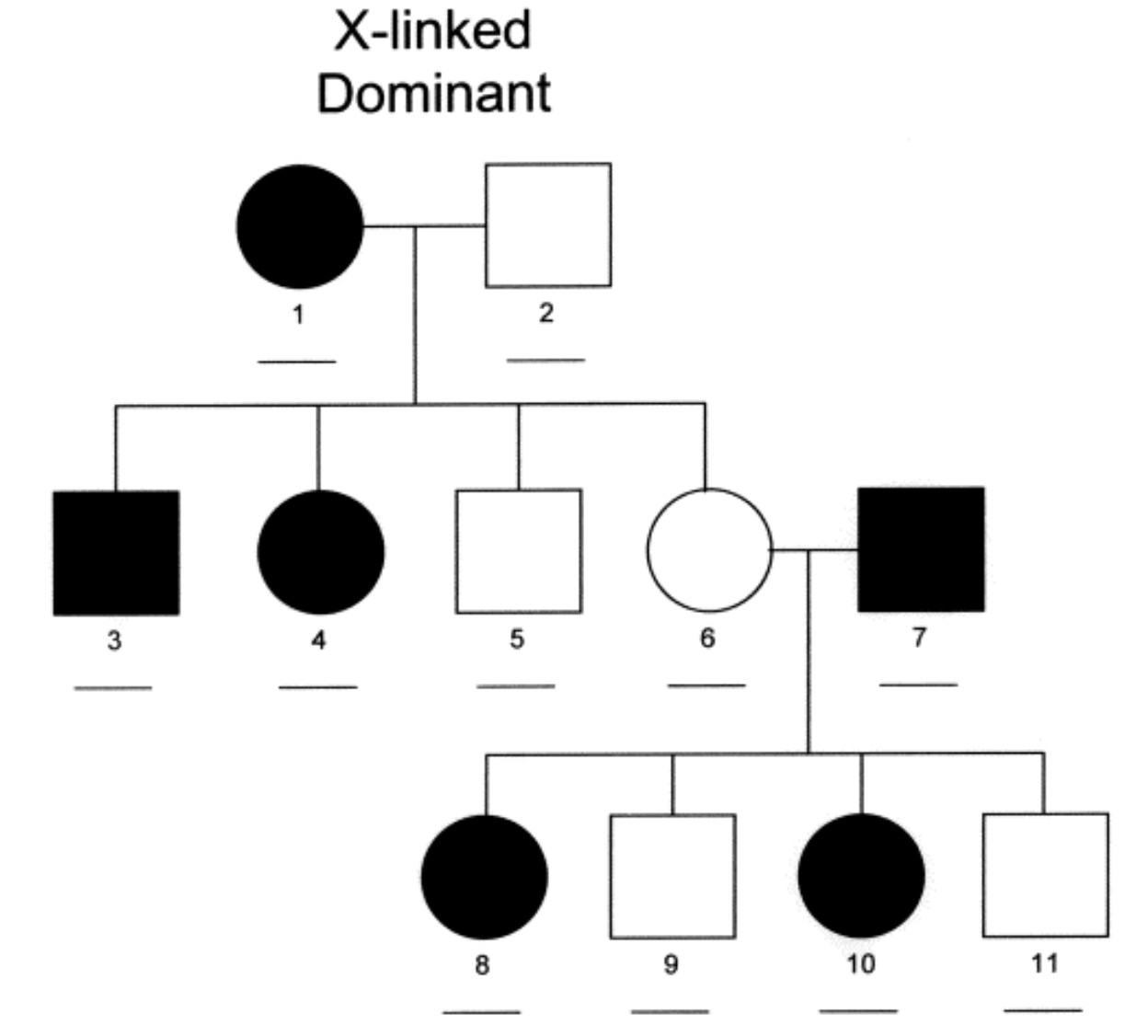
Affected fathers are unable to pass recessive traits to their sons because their son inherits one of the mother’s X chromosomes and the father’s Y chromosome. However, affected fathers pass their X chromosome to their daughter, meaning that the daughter will always be affected. Furthermore, if two affected parents have an unaffected son, the pattern will be one of the two possible dominant patterns. This assumes that the mother has a heterozygous sex chromosome pattern; that is to say, she has one dominant X chromosome and one recessive X chromosome. To have an unaffected son, the recessive X chromosome must be passed onto the son, and since the father will only be able to pass the Y chromosome down to his son, the son would thus be unaffected by the inherited trait/genetic disorder since it lies on the dominant X chromosome. This means that no family member can be a carrier of the inherited trait/genetic disease. To add onto this, all affected fathers will have affected daughters because they inherit one of their chromosomes from their father. Since the affected father has the dominant X chromosome and daughters only need one dominant X chromosome to express the trait/disease, the daughter will inherit that dominant X chromosome and thus express the trait/disease. Proceed with caution when applying this strategy because it’s easy to mix the logic up in your head, and sometimes it does not work.
Usually, an X-linked dominant pedigree does not tend to “skip” generations, but this doesn’t necessarily eliminate a X-linked recessive pedigree as a possible pattern that “skips” generations. Some classic examples of genetic traits or diseases that have an X-linked dominant mode of inheritance are Rett syndrome and fragile X syndrome. Below is an example of a pedigree depicting an X-linked dominant inheritance:
X-Linked Recessive
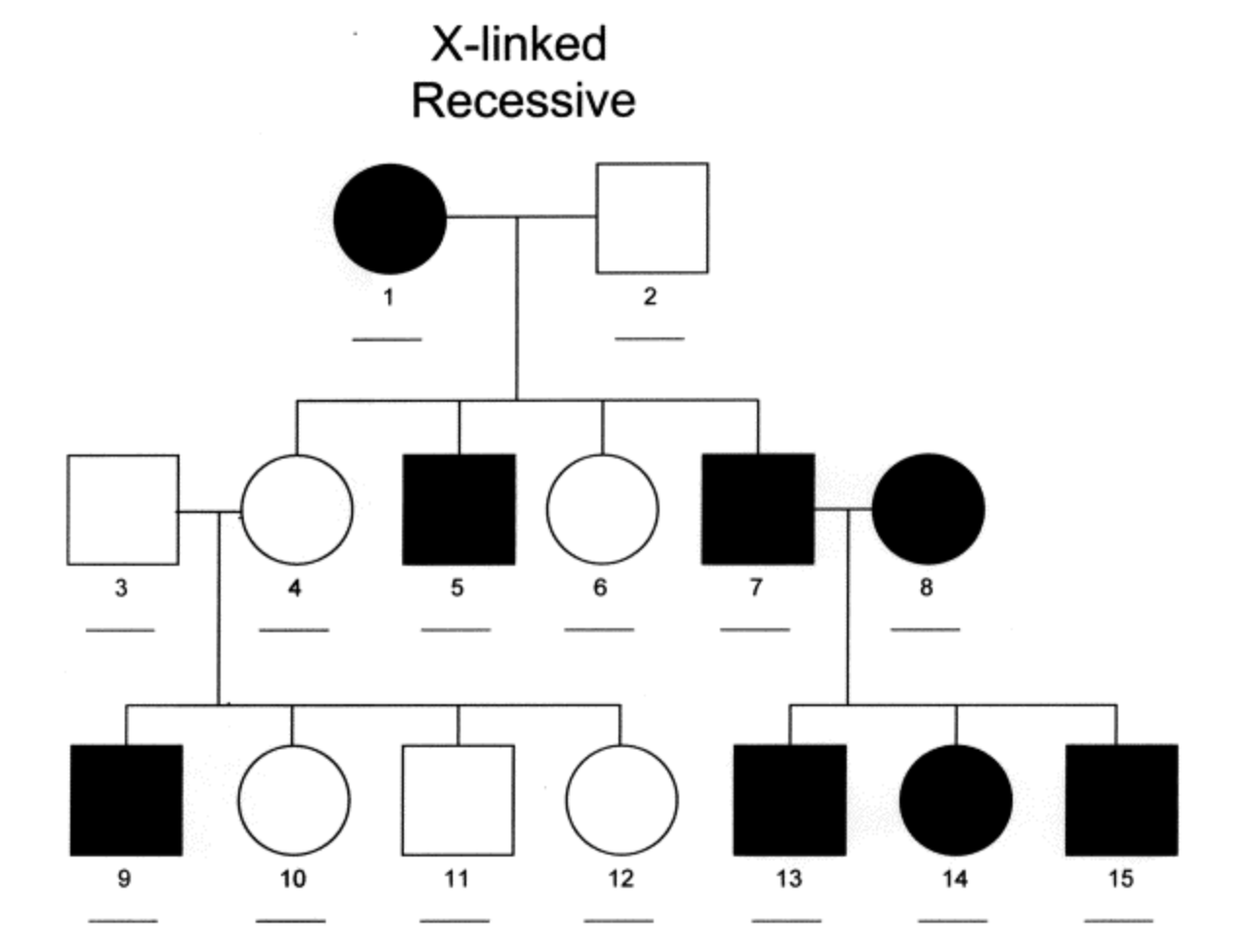
Just like recessive alleles, all X chromosomes that a descendant inherits must be recessive for the descendant to express the inherited trait/genetic disease. Using this definition, males are more likely to get affected than females because males need only one recessive X chromosome to express the recessive trait/genetic disease since their sex chromosome pattern is XY. Females, on the other hand, need both of their X chromosomes to be recessive to express the recessive trait since their sex chromosome pattern is XX.
Affected fathers are unable to pass the recessive trait to their son because their son inherits one of the mother’s X chromosomes and the father’s Y chromosome. Affected fathers can pass their recessive X chromosome to their daughter; however, this does not mean the daughter will be affected. The daughter will become a carrier of the trait, which means she will be unaffected by the trait but carry one dominant X chromosome and one recessive X chromosome (essentially has heterozygous sex chromosome pattern). If the mother is a carrier or is affected, then the daughter will be affected as well. If the father is unaffected, the daughter will not be affected.
If the mother is a carrier of the recessive trait, there is a chance that the son may inherit the trait. This means that if an unaffected mother and an unaffected father have an affected son, the pattern will be one of the two possible recessive patterns. This is because the mom can pass down the recessive X chromosome to their son and the father would pass the Y chromosome to his son, thus making him express the recessive trait. Furthermore, if the mother is affected by the recessive trait, all of her sons will be affected. Only females can be carriers.
It is also possible for a X-linked recessive pedigree to “skip” generations, but this doesn’t necessarily eliminate X-linked recessive as a possible pattern that does not “skip” generations. Some classic examples of genetic traits or diseases that have an X-linked recessive mode of inheritance are red-green colored blindness and Hemophilia A. Below is an example of a pedigree depicting a X-linked recessive inheritance:
Y-Linked
One of the easiest inheritance patterns you’ll learn in this course, Y-linked inheritance solely affects males (XY) across generations because the inherited trait lies on the Y chromosome. If a father is affected, all his sons are affected. If the father is unaffected, all his sons are unaffected. No females can inherit this trait. Below is an example of a pedigree depicting a Y-linked inheritance:
Non-Nuclear Inheritance
Non-nuclear inheritance is when traits are inherited through chromosomes that aren’t found in the nucleus. This is further discussed in AP Biology Topic 5.4.
Mitochondrial Inheritance
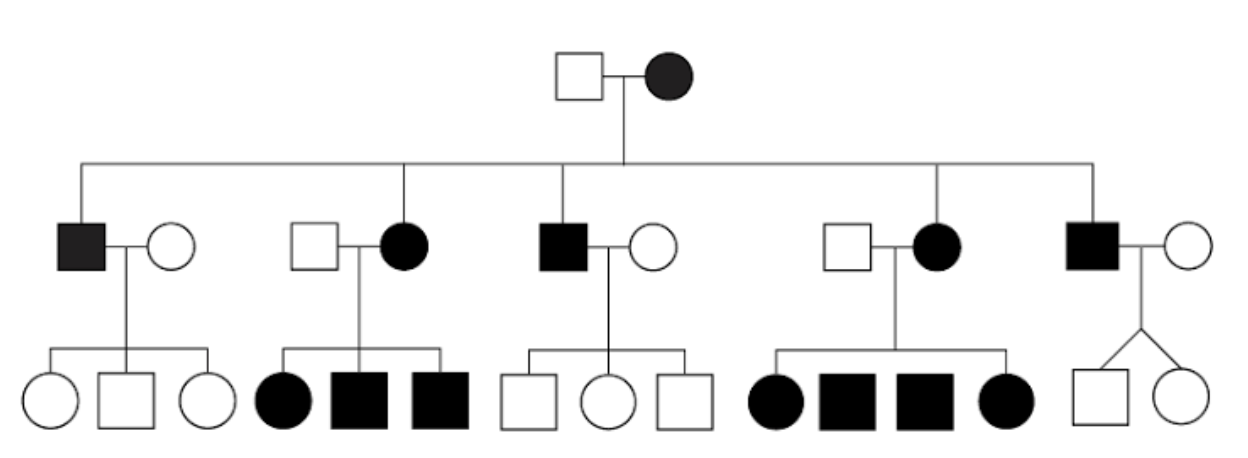
Mitochondrial inheritance affects mothers and all of their children. This is because the inherited traits lie on non-nuclear DNA (mitochondrial DNA, chloroplast DNA, or both), and all offspring obtain their mitochondria and chloroplasts from their mother. Below is an example of a pedigree depicting a mitochondrial-linked mode of inheritance:
Guided Example
Now, we will walk through an example of a pedigree question to form a set of guidelines and questions that students may want to ask themselves to complete the question. You may try to do this pedigree on your own if you wish.
Consider the pedigree below:
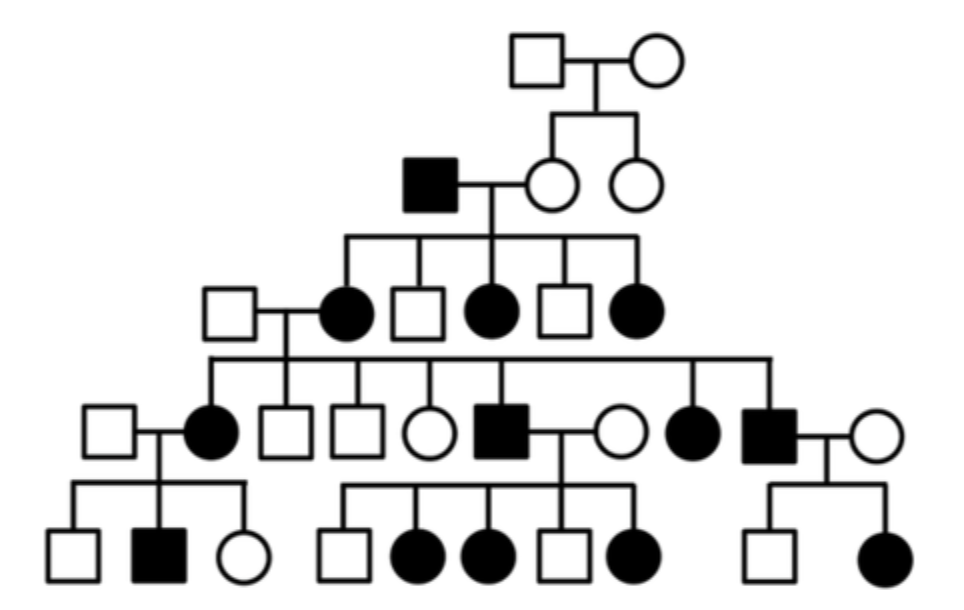
The first question you should ask yourself is, “What do I immediately notice about this pedigree?”
One thing you could notice is not all sons of an affected father are affected and not all children from an affected mother are affected. Thus, this pedigree cannot depict Y-linked inheritance nor mitochondrial inheritance. This can help you eliminate some modes of inheritance, and therefore, make it more likely that you find the correct mode of inheritance illustrated by the pedigree.
Another thing you could notice is how this pedigree doesn’t “skip” a generation. Although the first generation has no one affected, once one individual married an affected person, then the following generations had at least one person affected. This may lead you to think that this pedigree follows a dominant mode of inheritance.
The next thing you should do is to count the number of males and females affected. In this example, there is a discrepancy in the number of males and the number of females affected. If they count how many females and males are affected, represented by circles and squares respectively, they may notice 4 males have been affected while 9 females have been affected. Since this pattern depicts an unequal effect between males and females, we can conclude this is likely a X-linked inheritance.
Combining our theory that this pedigree follows a dominant mode of inheritance and an X-linked inheritance, along with the fact that more females are affected than males, it is extremely likely that the pedigree depicts X-linked dominant inheritance.
The second-to-last thing you should do is take a closer look at the pedigree again. “Is there anything weird that I may/did not notice before?” In this example, you may notice that every affected father has all of their daughters affected too. This provides further evidence that this pedigree depicts X-linked dominant inheritance.
The last thing you should do is to check the pedigree. You can do this by setting one chromosome as dominant and the other chromosome as recessive. However, if the pedigree depicts Y-linked inheritance or mitochondrial inheritance, you do not have to follow this step. because the pedigree patterns indicating each inheritance are obvious and easy to identify. In this example, you can set and indicate as dominant and as recessive (but any other combination works). Since we believe that the pedigree depicts X-linked dominant inheritance, set the affected males as because females may have homozygous or heterozygous X chromosomes. Going from there, check your work. If you encounter something that signals the pattern as impossible, recheck your work. If you confirm that the pattern is impossible, then the inheritance pattern you chose is likely incorrect, and you should either skip or retry the question.
We’ll let you check this if X-linked dominant inheritance fits this pedigree. If it does, congratulations! That is the correct mode of inheritance depicted by this pedigree. If not, double check your work.
Summary
- Affected mother has all of their children affected → Mitochondrial Inheritance
- Affected father has all of his sons affected → Y-linked
- Carriers (skipping generations), more males than females affected, affected fathers unable to pass traits to their sons → X-linked recessive
- Carriers (skipping generations), males and females equally affected → Autosomal Recessive
- No carriers (no skipping generations), more females than males affected, affected fathers all have affected daughters → X-linked Dominant
- No carriers (no skipping generations), males and females equally affected → Autosomal Dominant