
Topic 2.3/2.4 - Cell Membrane & Membrane Permeability
Introduction:
Welcome to AP Biology Topics 2.3 and 2.4: the cell membrane! These topics will introduce you to this essential structure of the cell that acts as a barrier between the cell’s internal and external environments.
The Completed Puzzle (Topic 2.4)
Cells require a barrier between their internal and external environments. This barrier needs to fulfill two key roles:
- Regulating the transport of substances into and out of the cell.
- Serving as a medium for cell communication.
Life’s answer to this? Cell membranes! All organisms have cell membranes, although some (such as plants, fungi, and some bacteria) have an additional layer of protection called a cell wall.
The cell membrane is made of phospholipids, which are amphipathic, meaning they contain both hydrophilic and hydrophobic regions. The head of a phospholipid is polar, and thus hydrophilic, due to the presence of a phosphate group (), which is a charged polar molecule. A phospholipid’s tail consists only of hydrocarbons, which are nonpolar and thus hydrophobic. This is visualized in the image below:

But you may be wondering: both the outside of a cell (which is made of extracellular fluid) and the inside of a cell (the cytoplasm) contain lots of water. So how on earth do phospholipids make up the membrane if they have a hydrophobic region? Where does the hydrophobic region go??? The answer is that cell membranes are made of two layers of phospholipids, with the hydrophilic heads facing the external and internal environments and the hydrophobic tails facing inwards (looking at each other). This model of the cell membrane is known as the fluid-mosaic model, and is visualized in the picture below:

Using the fluid-mosaic model, you can see how the hydrophilic heads are facing outwards towards the ICM (intra-cellular matrix) and ECM (extra-cellular matrix), and the heads are snuggled up facing each other.
The dual nature of the cell membrane makes it selectively permeable, meaning that it will only allow certain molecules to freely cross it. Due to the internal hydrophobic nature of the membrane (and because there is limited space between the phospholipids), only small, nonpolar molecules can pass freely through the cell membrane.
Below is a table that contains some common examples of molecules that can/cannot freely pass through the cell membrane. You should memorize this table.
The Puzzle Pieces (Topic 2.3)
You can also see that there are various proteins embedded in the cell membrane, but you may be wondering how they stay anchored in. Take a look at the image below:

Proteins that span the cell membrane have polar and nonpolar parts so that they are not repelled out. The nonpolar parts of the protein (alpha helices) are mostly located inside the membrane, while the polar parts of the protein stick out on either side of the membrane (kind of like how the phospholipid bilayer works). This allows for the protein’s alpha helices to get “stuck” inside the cell membrane, thereby “anchoring” the protein in the membrane.
*Note that the interior of the protein may be hydrophilic; the explanation above only pertains to the protein’s exterior surfaces.
**Note that if ANY part of a protein is charged, it qualifies as hydrophilic.
There are also a few other key components of the cell membrane:
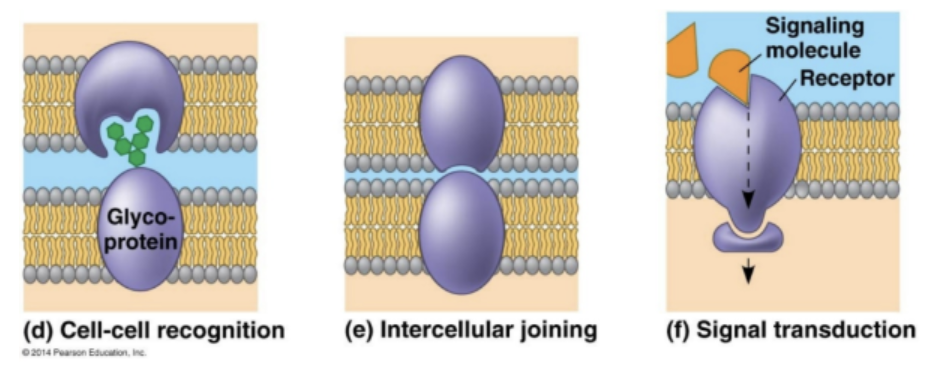
- Glycoproteins: Proteins that are found on the external side of the cell membrane. Their main roles include: cell-cell recognition, adhesion, and acting as receptors for signaling molecules (something you can learn more about in THIS article in Unit 4).
- Glycolipids: Lipid molecules that are found on the external side of the cell membrane. Their main role is to act as identifiers for their cell so other cells (e.g., immune system cells) can recognize it. Note that glycolipids are not phospholipids.
- Cholesterol: A type of steroid found inside the cell membrane, it helps to maintain the membrane’s fluidity by preventing phospholipids from packing together.
All of the components of the fluid mosaic model listed above can move around in the plasma membrane (because it is fluid-like).
Lastly, some cells also have cell walls around their cell membranes! Cell walls can be found in archaea, bacteria (made of peptidoglycan), and plants (made of cellulose - learn more in our Topic 1.4 article). Cell walls act as a kind of protective shield around the cell, helping the cell maintain structure and preventing it from lysing (learn more about that in our Topic 2.7 article).