
Topic 3.1/3.2 - Cellular Energetics: Enzymes and Environmental Impact on Enzyme Function
Introduction:
Welcome to Unit 3 of AP Biology! Unit 3 is one of the largest units of AP Biology. Luckily for you, we here at FiveHive break it down for you to make the chapter easily digestible… like what enzymes do!
Topic 3.1 is all about enzymes: proteins that accelerate biochemical reactions. This lesson will give you an overview on what enzymes are, their structure, and how an enzyme-mediated chemical reaction occurs.
Since Topic 3.2 is very short and closely related to 3.1, we’ll also be covering how changes in the cellular environment affect enzyme activity.
These changes can be influenced by a number of factors, including:
- Temperature
- pH
- The concentration of enzymes/substrates
Without further ado, let’s break this down!
What are Enzymes?
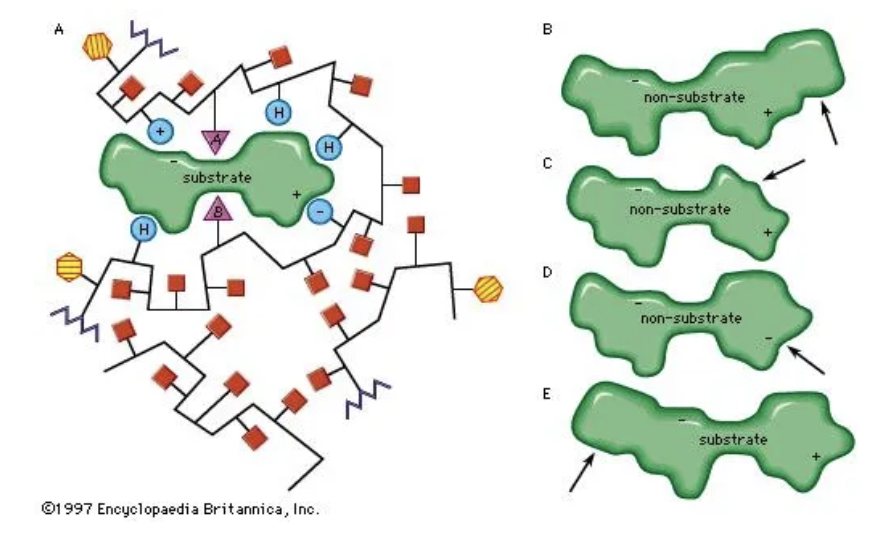
Enzymes are a class of proteins that act as biological catalysts, meaning they help with chemical reactions by speeding them up. Most of these chemical reactions are metabolic reactions, meaning they help to synthesize (create) and break down molecules. There are two types of metabolic reactions:
Catabolic reactions break down complex molecules into simpler ones (think hydrolysis, which you can learn more about in THIS article from Unit 1). Anabolic reactions synthesize simpler molecules into complex ones (think dehydration synthesis, which you can learn more about in THIS article from Unit 1).
Next, we’re going to discuss how enzymes work:
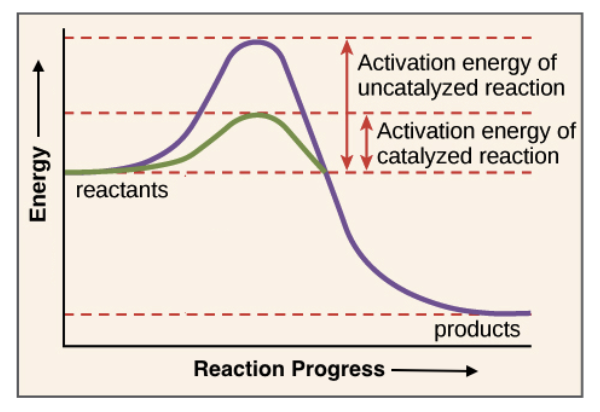
Reference the picture above for this next part. Reactants in a reaction must first turn into a high-energy molecule called the transition state. In order to reach this state, a certain amount of energy is required. This energy is called the activation energy.
Thus, with the help of enzymes, the reaction can occur more quickly since the transition state (the peak in the diagram above) is not as hard to overcome. However, enzymes do NOT change the energy of the starting point or the end point of the reaction—they only lower the activation energy.
Many crucial reactions that occur in the cell require enzymes. Yet, enzymes themselves are highly specific and can only catalyze one kind of reaction (this is called enzyme specificity). Because of this, enzymes are usually named after the molecules they target, which are called substrates.
Enzymes are composed of amino acid chains folded into specific 3D shapes. The active site of an enzyme is the pocket where a substrate binds and a reaction occurs. The specificity of an enzyme is determined by the active site’s shape and chemical properties.
How does an Enzyme-Mediated Chemical Reaction Occur?
During a reaction, the enzyme’s job is to bring the transition state about by helping the substrate get into position. This is done at the active site.
The enzyme temporarily binds one or more of the substrates to its active site and forms an enzyme-substrate complex. Due to enzyme specificity, the structure of the substrate (its shape and charge) must be compatible with the active site of the enzyme in order for the reaction to occur.
This specificity can be best represented by the lock and key model.
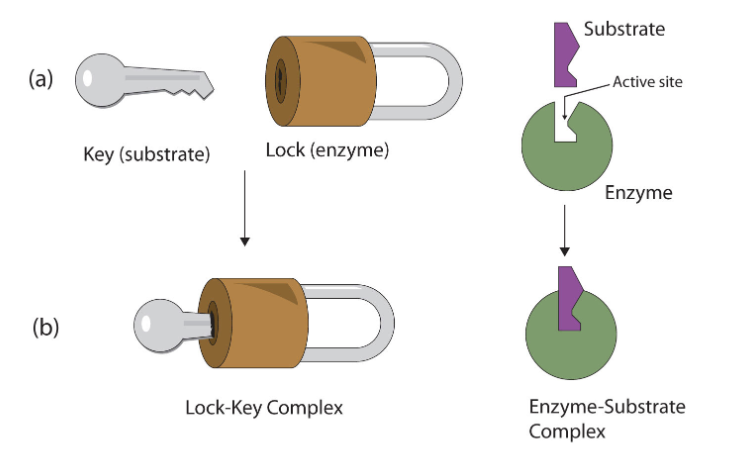
Think of the key as the substrate, and the lock as the enzyme.
Each lock and key has a specific structure that allows the key to open the lock. Every enzyme has a specific active site that only allows for a specific substrate to bind to the enzyme.
However, there are cases where the specific substrate cannot bind to the active site of an enzyme. In order for a substrate to bind properly, it must undergo some conformational changes (changes in shape). This change is called an induced fit.
Once the enzyme does its job and the product(s) are formed, the product(s) are released from the complex, and the enzyme returns to its original shape. The enzyme is not consumed once finishing with the substrate, and instead begins circulating around the solution again, ready to facilitate more reactions.
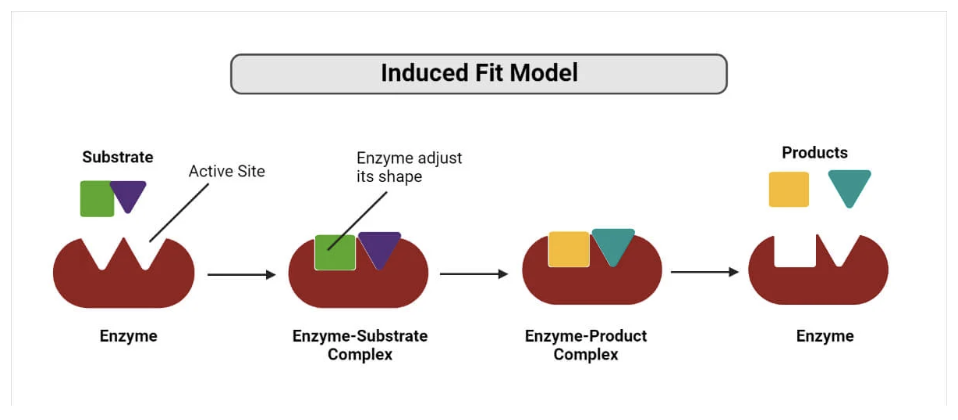
Finally, the enzyme is free to react again with another bunch of substrates. By binding and releasing substrates over and over again, the enzyme speeds up reactions, enabling the cell to release necessary energy from various molecules.
Here’s a quick review on the function of enzymes:
Enzymes DO…
- Increase the rate of a reaction by lowering reaction’s activation energy
- Form temporary enzyme-substrate complexes
- Remain unaffected by the reaction
Enzymes DON’T…
- Change the reaction.
- Make reactions occur that would otherwise not occur at all.
Now that we’ve covered what an enzyme is and its functions, let’s figure out what exactly affects enzyme function and activity!
Temperature Effects on Enzyme Activity
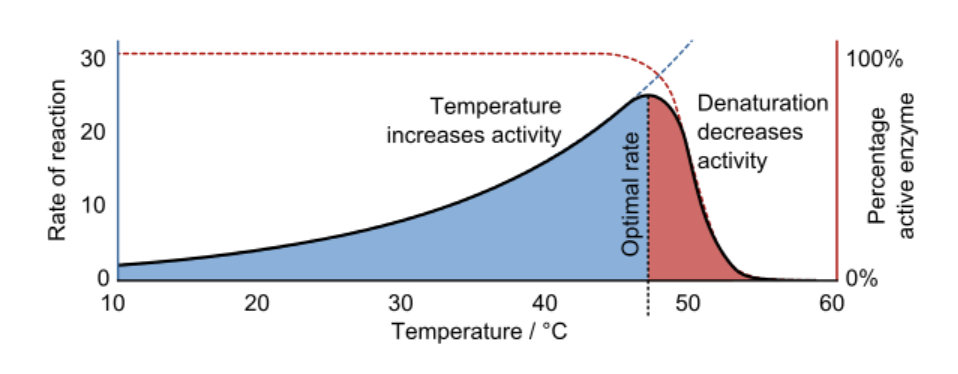
The rate of a reaction increases with an increase in temperature. Higher temperatures provide more kinetic energy to enzyme and substrate molecules, allowing them to move faster, which in turn causes more collisions between the two.
However, this improvement only lasts until up to an optimum temperature (the most favorable temperature for the process to function at its highest efficiency).
Beyond the optimum temperature, enzyme activity decreases due to protein denaturation (which you can learn more about in THIS article in Unit 1). In essence, too much heat can damage an enzyme, making it lose its three-dimensional shape. The structure of a protein is incredibly important to its function, so when it’s changed, its function changes as well, and thus the enzyme loses its ability to function. All enzymes operate at different optimum temperatures.
Denaturation is the process where an enzyme loses its specific three-dimensional structure, resulting in the loss of its biological function and thus inability to catalyze a reaction. However, in some (albeit very few) cases, the denaturation of an enzyme is actually reversible, and the enzyme is able to regain its function (this process is called renaturation).
A real-world example of denaturation is alcohol-based hand sanitizers. The alcohol works by denaturing the proteins within bacteria and viruses, making them ineffective and unable to cause infections (see the image below).
pH Effects on Enzyme Activity
Just like how enzymes have optimal temperatures they operate in, they also have optimal pH ranges, which are once again different for every enzyme.
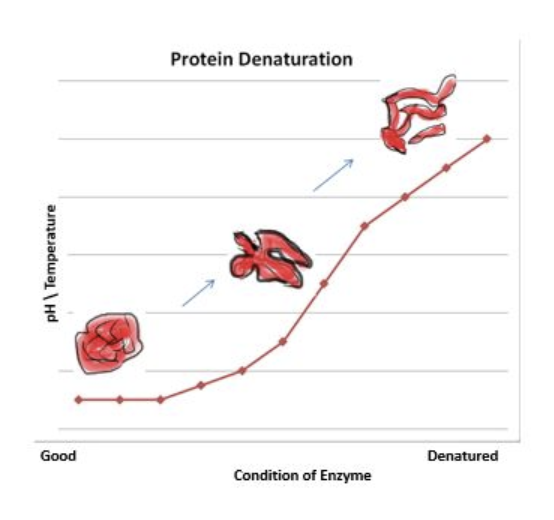
pH affects the ionization (gaining or losing of electrons) of the amino side chains in the active site of the enzyme. Extreme pH levels can denature enzymes by disrupting the ionic and hydrogen bonds that hold the enzyme’s three-dimensional structure together. If the structure of the enzyme is altered, particularly in the active site, substrates will be unable to bind to the enzyme. The graph below illustrates this concept.
Substrate Concentration’s Effects on Enzymes
The relative concentration of substrates and products within the space can also affect the rate of enzymatic reactions.
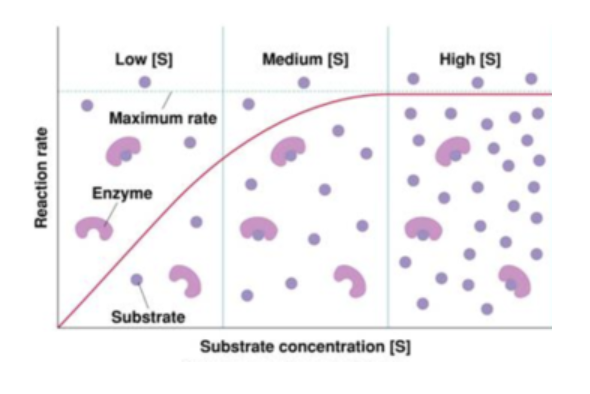
An increase in substrate concentration will initially speed up the reaction. However, once all of the enzymes in a solution are bound by substrate, the reaction can no longer be sped up. This instance, where all the enzymes in a solution are “occupied,” is called the saturation point. Adding substrate into a solution past this point will no longer increase the speed of the reaction, unless you add more enzyme as well.
Product Concentration’s Effects on Enzymes
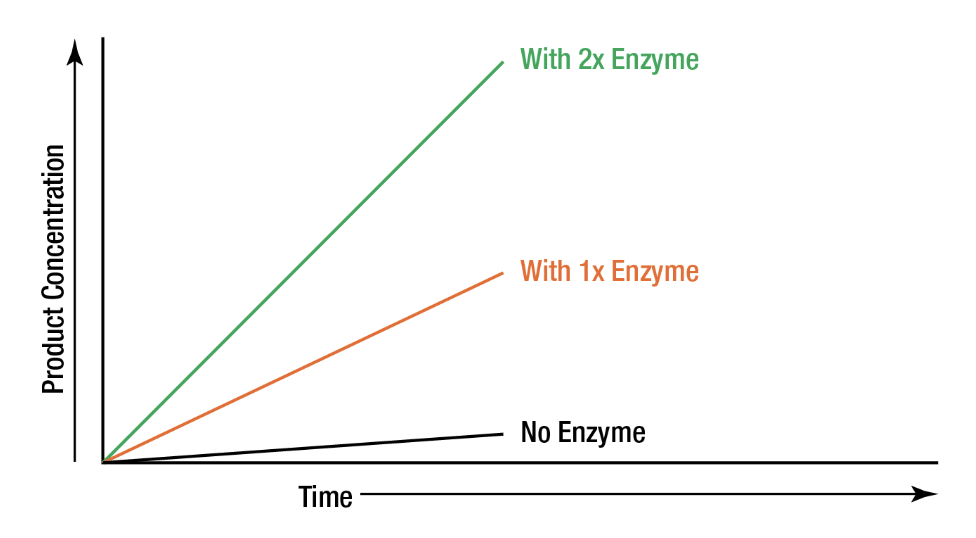
Like substrate, the amount of product present in a solution can affect enzyme reaction rates. High product concentration generally decreases enzyme reaction rates by accidentally blocking substrate from the enzyme’s active site.
As shown in the graph below, accumulation of product slows down the reaction, preventing the overproduction of the substance. Another reason for this is it helps conserve cellular resources.
Categories of Enzyme Factors
Now that we’ve covered the different enzyme factors, let’s categorize them!
The factors that directly affect enzyme structure are: temperature and pH.
The factors that deal with the cellular environment are substrate concentration and product concentration. Now let’s talk about inhibition!
Enzyme Regulation
In addition to enzyme factors, we need to talk about enzyme regulation. A cell can control enzymatic activity by regulating the conditions that influence the shape of an enzyme.
Enzymes can be “turned on and off” depending on what binds to them. Sometimes these substances bind at the active site, and sometimes at other sites called allosteric sites. When an allosteric inhibitor binds to the allosteric site, the enzyme is either turned on or off. The allosteric inhibitor causes a conformational change, reducing enzyme activity. It’s often part of feedback inhibition in metabolic pathways. Allosteric inhibitors are also called noncompetitive inhibitors as the inhibitor doesn’t bind to the active site, but still prevents the enzyme from catalyzing the reaction. See the image below for a visual representation of this concept.
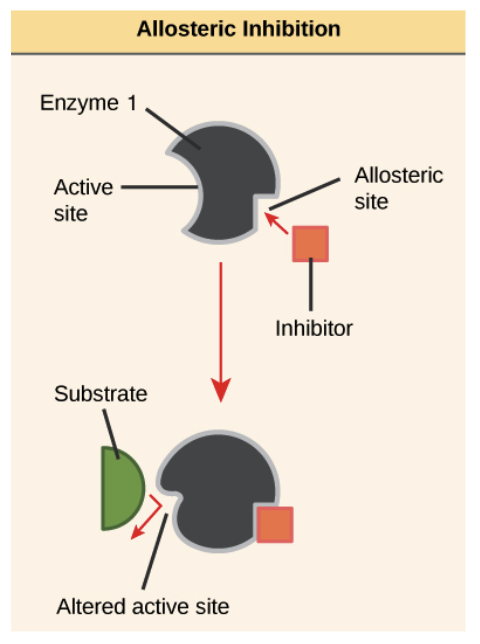
Note: Not all molecules that bind to the allosteric site are inhibitors. Some are regulators that turn on the enzyme.
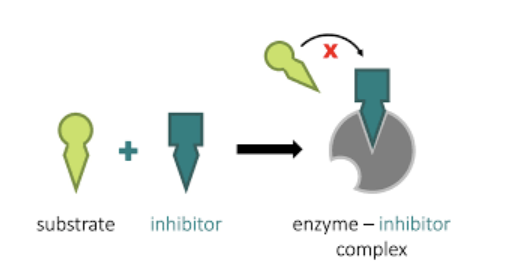
If a substance has a shape that fits the active site of an enzyme, it can compete with the substrate and block the substrate from getting into the active site, and is called a competitive inhibitor. These inhibitors act as a replacement for the substrate, except they do not stimulate the enzyme in any way, acting like a “placebo”. See the image below for a visual representation:
Practice Questions: