
Introduction
In this topic, you’ll learn about the key characteristics of polynomial functions related to rates of change. In the last topic, we discussed rates of change of linear and quadratic functions, and now we are extending the idea of rates of change to all polynomial functions.
What Makes Up a Polynomial Function?
A polynomial is an expression that can be expressed in the general form:
In this function, the value of , or in other words, the largest exponent on a term within a polynomial, is called the polynomial’s degree. The degree determines the general shape and plays a role in determining the end behavior of the graph.
must be real numbers; they can affect the “steepness” of the graph but knowing the effects of these coefficients is not of utmost importance in Precalculus.
is the leading coefficient–it is the coefficient of the term with the highest power. The sign of influences the general shape of the function as well as its end behavior, which we will delve into more deeply in later sections of this topic.
is the leading term. This term can be useful for evaluating limits, but for Precalculus, it is more useful for determining the behavior of the graph. Although, the components that make up the lead term and the leading coefficient and degree are useful for determining graph behavior.
Occasionally, you might see a function like . This is still considered a polynomial function, just with a degree of zero. Polynomial functions cannot have negative exponents (in their simplest form).
Global Extrema and End Behavior
The degree of the polynomial will show whether or not the graph has a global extrema (a maximum or minimum) under a specified interval or under the entire domain (although for polynomials, the entire domain might not host a global extrema).But first, let’s discuss how even and odd degrees affect the function. Polynomials with an even degree point in the same direction at both ends.In other words, the limits of the function are as , , or,
As , .
Whether the function approaches positive or negative infinity is dependent on the leading coefficient and will be discussed soon.
When both ends of the function approach infinity, then the function does not have a finite maximum, and thus does not have any global maximum (though, it will have a minimum). The same is true for when the function approaches negative infinity, only instead the function will now have a global maximum.
With odd degrees, however, the function will have ends that point in opposite directions (one end to , the other to and vice versa)
Thus, the takeaway for polynomials of odd degrees is that they generally do not have global extrema, assuming the domain/range is not restricted.
The Effect of the Leading Coefficient
The leading coefficient– the coefficient that is attached to the term of highest power within a polynomial (remember )– determines whether the limit of the polynomial as is or . If the lead coefficient itself is positive, then the limit of the polynomial as is . If the lead coefficient itself is negative, then the limit of the polynomial as is .
Note: Make sure that when you’re finding the lead coefficient, the entire term is in simplest form, and there is either one or zero negative signs throughout the entire term.
Then, using the degree rule you learned in the previous section, you can find the end behavior of the graph as (if the degree is even, both sides approach the same way; if it is odd, then the sides approach opposite directions).
Zeroes and Local Extrema
Between every two distinct real zeroes of a nonconstant polynomial, there is at least one local extremum. This is fundamentally true (putting in a bit of thought can make it clear).
Additionally, local extrema– and occasionally, global extrema– will be present every time the function goes from increasing to decreasing or decreasing to increasing. In other words, the ROC goes from positive to negative or negative to positive.
Concavity and Points of Inflection
The term “rate of change (ROC),” or slope, tells us if a function is increasing or decreasing (if the ROC is positive, the function is increasing and vice versa). However, the ROC itself can also increase or decrease (a topic that will be heavily emphasized in later calculus courses). We use the concept of “Concavity” to describe how the ROC is changing, like we’ve discussed in previous topics.
When a segment of the function is Concave Up, the rate of change is increasing.
A portion of the graph that is concave up will look like
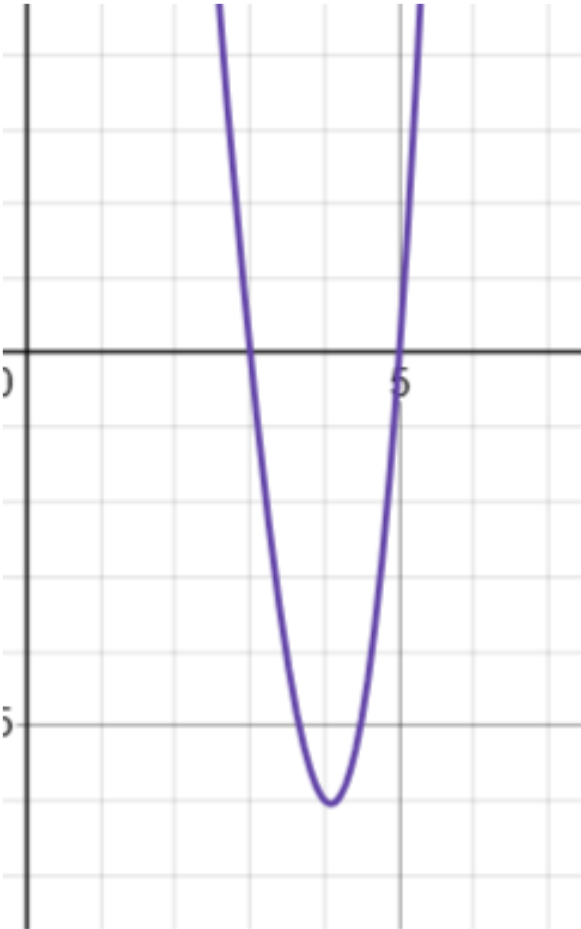
A common phrase to remember how it looks is “Concave up like a cup.”
When a segment of the function is Concave Down, the rate of change is decreasing. A portion of the graph that is concave down will look like
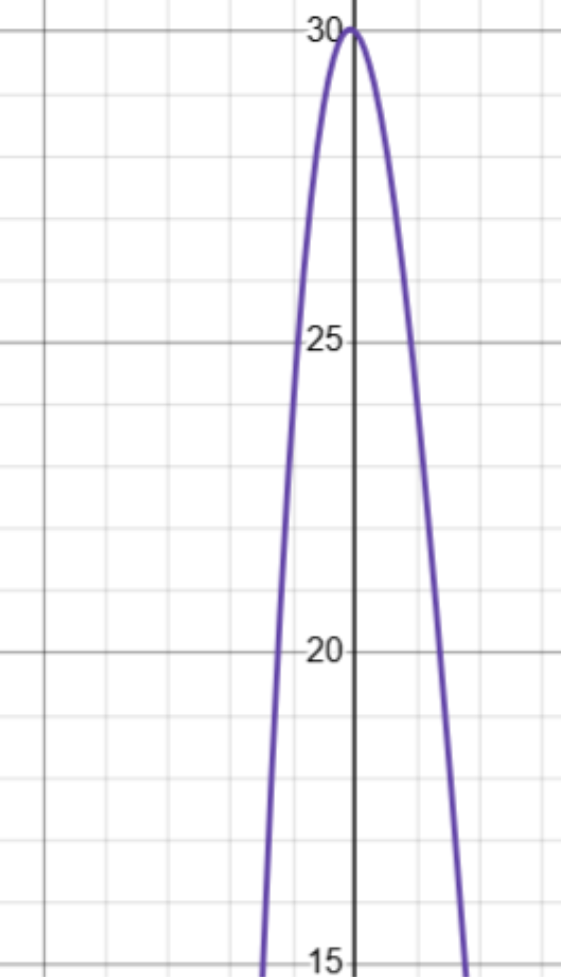
A common phrase to remember how it looks is “Concave down like a frown.”
A Point of Inflection is a specific location on the graph where the concavity changes. Basically, it is the specific point that marks when the function switches from concave up to concave down, or from concave down to concave up. The point of inflection can also be thought of as the place where the ROC goes from increasing to decreasing or vice versa. In this class, you will not have to calculate the Point of Inflection; typically, when looking at a graph, you will be able to tell where it is.
Practice
MCQ
Free Response
1) A polynomial function has the leading term . If is an even integer and , describe the global behavior (end behavior, global extrema) of the function
2) A polynomial has distinct real zeros at and . According to the properties of polynomial functions, what is the minimum number of local extrema that must have?
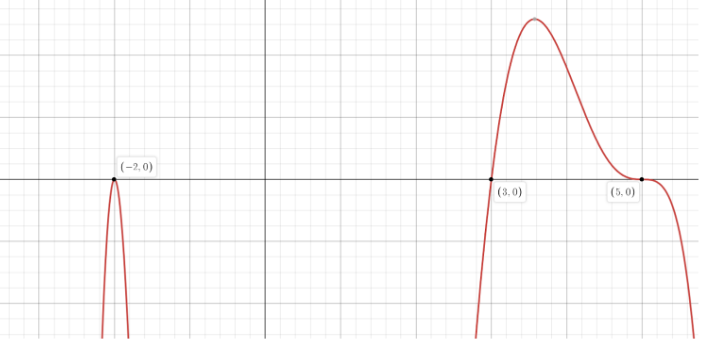
3) Find an equation to describe this graph:
Free Response Answers
1) A polynomial function has the leading term . If is an even integer and , describe the global behavior (end behavior, global extrema) of the function
Answer:
is even and so both ends of the function approach negative infinity.
Because both ends approach negative infinity, the function has a global maximum and no global minimum
2) A polynomial has distinct real zeros at and . According to the properties of polynomial functions, what is the minimum number of local extrema that must have?
Answer:
A nonconstant polynomial must have at least ONE local maximum or minimum between every TWO distinct real zeroes. This has the implication that for every number of zeroes, there is an number of local extrema. So, there are a minimum of local extrema.
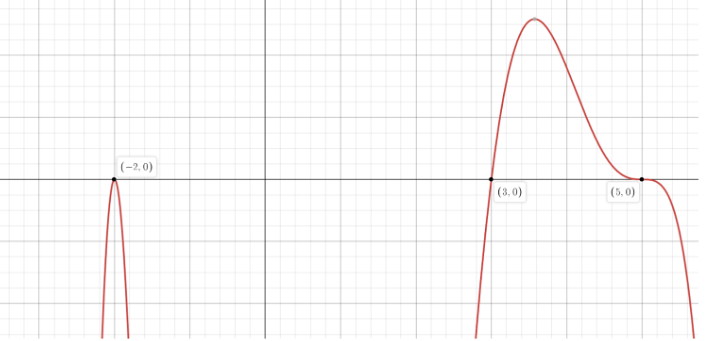
3) Find an equation to describe this graph:
Answer:
There is a root at and it bounces off, suggesting an even multiplicity (we will use for simplicity’s sake). Our first term is .
There is a root at . The graph crosses it without any warping, suggesting a multiplicity of 1. Our second term is
There is one final root at and it flattens out before crossing, which implies an odd multiplicity that is also greater than one (we will use for simplicity’s sake). Our third and final term is
Both ends of the function point towards the same direction and towards , implying the final polynomial should have an even degree as well as a negative lead term. To take care of the negative lead term, we will be simple and just use
Thus, our final function is
Note, in replacement of , you could have used any negative real number (since no scale was given for the -axis)
In replacement of the exponent of , you could have technically used any even exponent (greater than zero)
In replacement of the exponent of , you could have technically used any odd exponent (greater than one), though, you may have a hard time arguing that the flattening shown can be reasonably expressed by any exponent greater than .