
Introduction
Howdy! Today we will be going over polynomial functions and their end behavior, which is basically how the output of a polynomial behaves as we increase or decrease the input by very big values. Additionally, we will be introducing you to limit notation, which is important for not only the AP Precalculus exam, but also for evaluating limits in a calculus course.
Course and Exam Description Breakdown
The AP Precalculus Course and Exam Description (CED) states that you need to know the following for the AP Exam:
- The end behavior of a polynomial as its input increases without bound (in other words, how the output of a polynomial behaves as its input approaches infinity)
- The end behavior of a polynomial as its input decreases without bound (in other words, how the output of a polynomial behaves as its input approaches negative infinity)
- How to determine the end behavior of a polynomial based on the sign of the leading coefficient as well as its power.
Introduction to Limit Notation
In AP Precalculus, you will need to describe the end behavior of polynomial functions using limit notation. This may be different from the notation you used in elementary algebra, which is most likely interval notation. It is especially important for the free-response section to be familiar with limit notation.
An example of how limit notation works is shown below. For this example, we will be evaluating the end behavior of as approaches positive infinity.
You’ll see that lim is what you will write to represent a limit. Below lim, you will indicate your input variable (in this example, it is , but you may sometimes see other variables like or ) and what value (or infinity) your input variable is approaching. Lastly, after the lim script, you will indicate your function. In this example, the limit of as approaches infinity is equal to positive infinity.
Example 1: Express the following statement in limit notation:
The limit of as approaches negative infinity is four.
Solution 1: We will identify our function as , and that approaches negative infinity. As such, we can now write the first part of our limit statement:
However, we also need to identify what the limit is equal to. The statement indicates that the limit of as approaches negative infinity is equal to four. Thus, we will also write that:
Some other notes:
- Always identify the function you are evaluating the limit of! This may seem trivial, but from my experience in AP Precalculus, many people tend to forget to write the function they are taking the limit of. As such, they will write something like this: . This does not really tell us anything. This is especially a problem when a question refers to two or more functions; if you do not identify the function you are evaluating the limit of, you are not evaluating the limit of any function.
- A function’s limit may not be evaluated. If that is the case, write “Does Not Exist (DNE).” Certain functions may not have a proper end behavior, such as certain trigonometric functions in Unit 3. As a result, you may not be able to evaluate the limit of said functions as their input approaches infinity. If this is the case, state that the limit does not exist.
Now let’s get to evaluating the end behaviors of polynomial functions. One thing to note is the vocabulary I’ll be using when referring to certain types of functions. I will provide a list below:
- Odd polynomials are polynomials where the leading term (with the highest power) has an odd power, such as or .
- Even polynomials are polynomials where the leading term (with the highest power) has an even power, such as or .
- Decreasing without bound means that the function approaches negative infinity as the input values increase or decrease infinitely.
- Increasing without bound means that the function approaches positive infinity as the input values increase or decrease infinitely.
Evaluating the End Behavior of Polynomial Functions Based on the Degree of the Leading Term
So, what even is the end behavior of a function?
The end behavior of a function basically states what value the function approaches as its input increases or decreases without bound. Basically, we are trying to find what value the function would approach if we continuously increased or decreased its input values by very large amounts. Let’s show this in a graphical manner:
Example 2: Evaluate the end behavior of the graph as increases and decreases without bound. Express your answer using the mathematical notation of a limit.
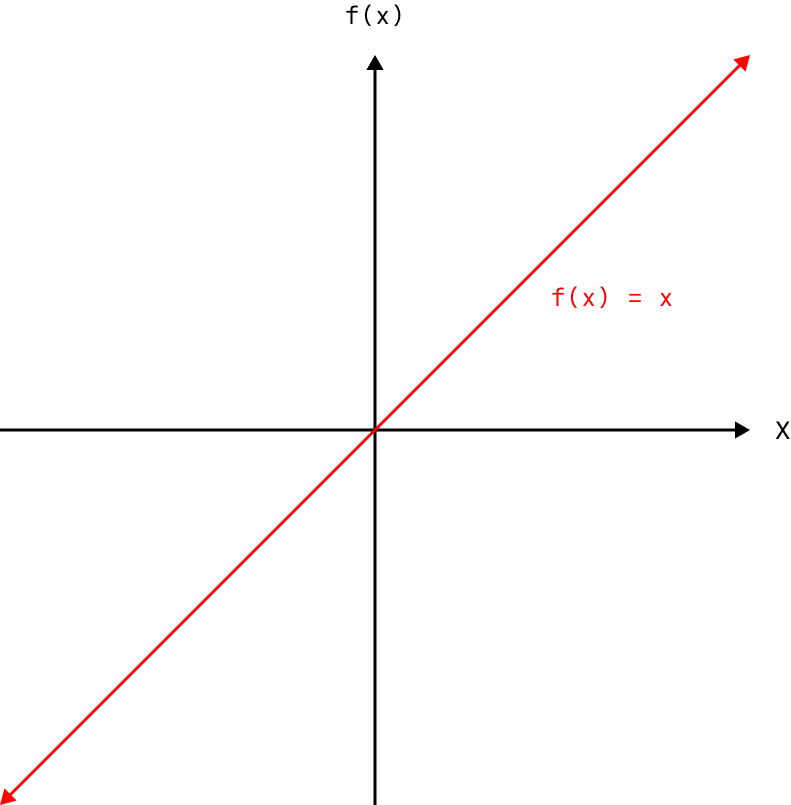
Solution 3: To evaluate end behavior, simply look at where the graph is headed. For this first example, we can see that the graph does not stop increasing heading right, and does not stop decreasing heading left. Therefore, we know the following:
● As the input increases without bound, is also increasing without bound.
● As the input decreases without bound, is also decreasing without bound.
That is the end behavior. But we were asked to express our answer using the mathematical notation of a limit! What does that even mean?
Well, that’s just asking us to use limit notation to express the end behavior of the function. The AP Program will always use this language in free-response questions when they ask us to evaluate end behaviors of functions. So let’s go ahead and do that:
Example 3: Evaluate the end behavior of as increases and decreases without bound. Express your answer using the mathematical notation of a limit.
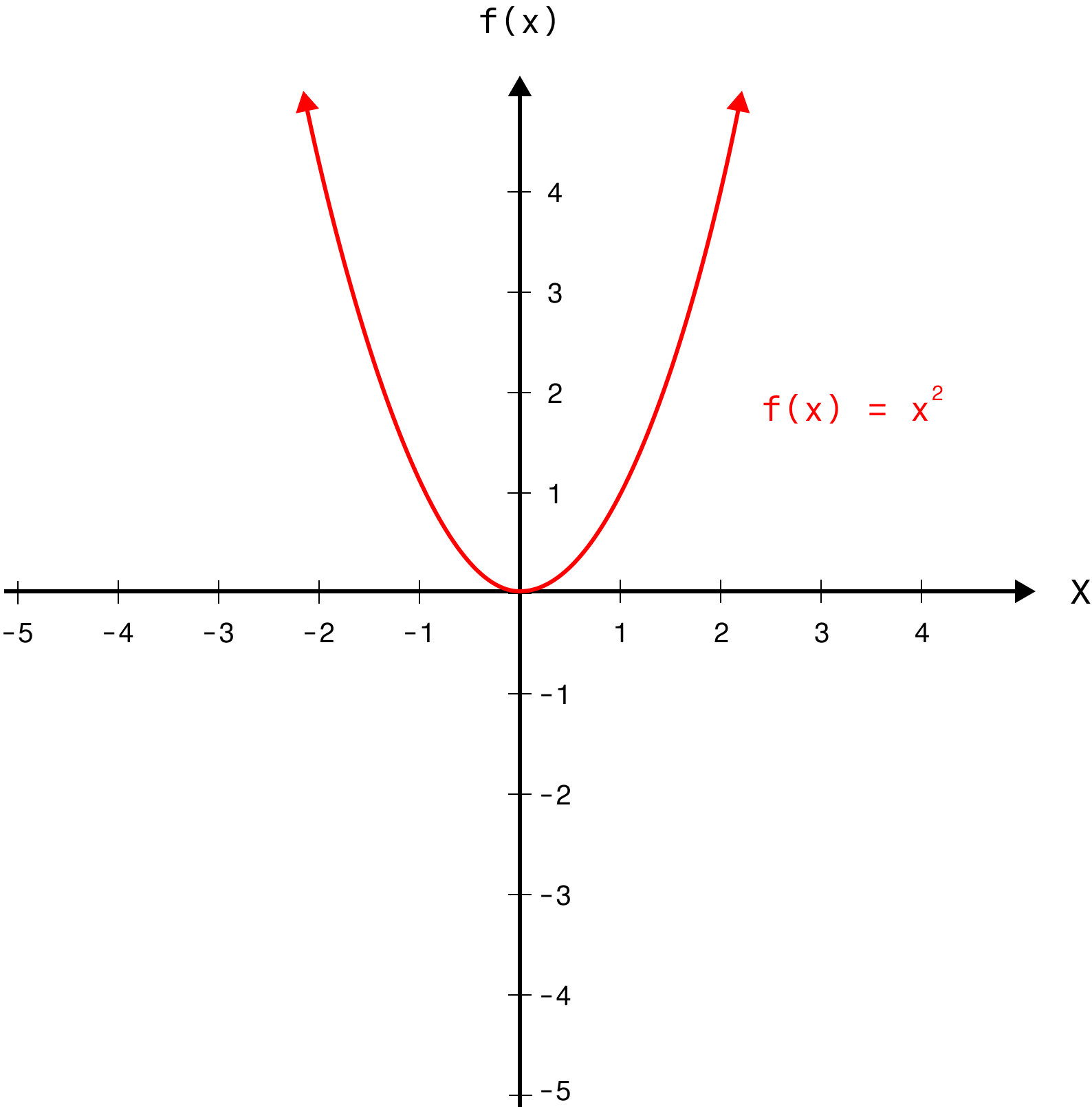
Solution 4: We will once again look at where the graphs are headed in either direction; in this case, whether the input increases without bound or decreases without bound, the function will increase without bound. Therefore:
While evaluating the end behavior of functions using graphs is simple, we will not always have a graph at our disposal. However, this doesn’t spell the end of the world! We can evaluate the end behavior of polynomial functions simply based on the leading term; the term with the highest power. The leading term will sort of “guide” the remaining terms towards the end behavior of the leading term.
Evaluating the End Behavior of Polynomial Functions Based on the Power of the Leading Term
The first step to evaluating the end behavior of polynomials is to look at the degree of the leading term. What we are going to check is whether it is odd or even.
The end behavior of functions with a leading term raised to an even power will be the same for both positive infinity and negative infinity. For example, if the function decreases without bound as its input variables approach positive infinity, it will also decrease without bound as its input variables approach negative infinity.
The end behavior of functions with a leading term raised to an odd power will be the opposite for negative infinity and positive infinity. For example, if the function decreases without bound as its input variables approach positive infinity, the function will increase without bound as its input variables approach negative infinity.
Evaluating the End Behavior of Polynomial Functions Based on the Sign of the Leading Term
Now that we have identified the degree of the leading term of the polynomial, we now need to look at the sign of the leading term. When a function approaches positive infinity, we can be sure of two things based on the sign of the leading term alone.
(1) The end behavior of polynomials where the leading term has a positive coefficient as their input increases without bound will generally be positive infinity (the polynomial will increase without bound).
(2) The end behavior of polynomials where the leading term has a negative coefficient as their input increases without bound will generally be negative infinity (the polynomial will decrease without bound).
Once we evaluate the end behavior of a function based on the sign of the leading term, we can use our knowledge of the degree of the leading term to determine the end behavior of the polynomial as its input decreases without bound. Generally, if a polynomial is of an even degree:
(1) if the leading coefficient is negative, the polynomial will decrease without bound as its input either increases or decreases without bound.
(2) if the leading coefficient is positive, the polynomial will increase without bound as its input either increases or decreases without bound.
And generally, if a polynomial is of an even degree:
(1) if the leading coefficient is negative, the polynomial will decrease without bound as its input increases without bound, and the polynomial will increase without bound as its input increases without bound.
(2) if the leading coefficient is positive, the polynomial will increase without bound as its input increases without bound, and the polynomial will decrease without bound as its input increases without bound.
Example 4: Evaluate the end behavior of the polynomial as increases without bound.
Solution 4: We will first identify our leading term, . Now, we will determine the sign and the coefficient of this leading term. Based on the leading term being raised to an even degree and its sign being positive, we know that increases without bound as the input increases without bound. Let’s write this in limit notation:
Example 5: Evaluate the end behavior of the polynomial as decreases without bound.
Solution 5: We will first identify our leading term, (Note: Our leading term is not the first term of the polynomial! It is the term raised to the highest power.). We will now determine the sign and the coefficient of this leading term; the leading term is negative and raised to an odd degree. Therefore, we know that increases without bound as the input decreases without bound. Let’s write this in limit notation:
And there you have it; you now know how to evaluate the end behavior of polynomials! You will use many of these skills, especially knowing how to use limit notation, in the next topic (1.7), which is evaluating the end behavior of rational functions.
Practice Problems
For Problems 1-4, evaluate the end behavior of each function as increases without bound and as decreases without bound. Express your final answers in limit notation.
For Problems 5-8, write a polynomial function that satisfies the following conditions:
For Problems 9-12, evaluate the end behavior of each graph as increases without bound and as decreases without bound. Express your final answers in limit notation.




AP Practice Problem: Free-Response Question 1, part (b-ii) from the 2025 AP Precalculus Exam, Form O:
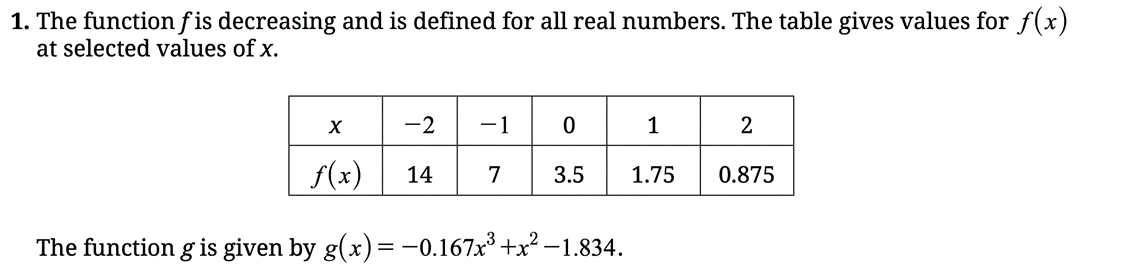
Determine the end behavior of as increases without bound. Express your answer using the mathematical notation of a limit.
ANSWER KEYS FOR THE PRACTICE PROBLEMS
- and
- and
- and
- and
Note: For problems 5-8, there are no definitive answers. A variety of functions could satisfy these conditions each problem asks for. However, the answers provided below are one example of a polynomial that could satisfy the conditions.
- and
- and
- and
- and
AP Practice Problem 1:
Note: This is from the 2025 AP Precalculus exam, which does not have released scoring guidelines yet. The following solution may change in the future to reflect the scoring guidelines from the 2025 exam.