
Introduction
Welcome back, and today we will be revisiting the topic of inverse functions yet again! This time, we will be continuing to work on trigonometric functions and discuss the inverse of our trigonometric functions. In other words, we will get to know what the inverse of , , are including other functions!
Inverse Functions
Just for a review, remember that an inverse function is a function that when given the output, it spits back the output.
For example, let’s have . If is the inverse function of , then . Notice that the input of is the same as the output of , and the output of is the same as the input of .
Remember that is how we would represent the inverse of .
An inverse function should also satisfy the equation, , where is our original function and is the inverse function.
One more last thing. The domain of the original function is the same as the range of the inverse function, but we will get into exceptions to this rule very soon. But let’s just assume for now there’s no exceptions.
This mean that if has a domain of and a range of , this means that the domain of is and the range is
Inverse Trigonometric Functions Notation
Let’s familiarize ourselves with the notation of the trigonometric functions. Remember that is how we would represent the inverse of . If that’s the case, then it makes sense that is how we would represent the inverse of . As such, we can go down the list. is how we represent the inverse of , and so on.
There’s also another notation, and it is simply by adding “arc” to the front of the name. For example, the inverse of is , and the inverse of is . This “arc” notation is a bit less common on the AP Exam, but it is still a notation that you will need to familiarize yourself in. I am going to use both notations frequently in this article so you can be familiarized with the notation while reading this article.
Domain and Ranges of Inverse Sine
Let’s try to get a feel for these trigonometric inverses. If we have , we get . This means that . If we have , we get . This means that . Notice the trend? This means that we can simply take every output and link it with its input, and we have a proper graph of ! However, there is just one problem. Let us do so that our inverse would be . Notice how we get the same output for and . This periodicity is making it so that one output corresponds to an infinite number of inputs.
To fix this issue, we can simply pick an interval for the function where we can represent the function to its fullest without causing one output to be linked to one input. Remember, our two main goals is to find an interval that contains all the possible -values of , and also doesn’t cause one -value to be mentioned twice.
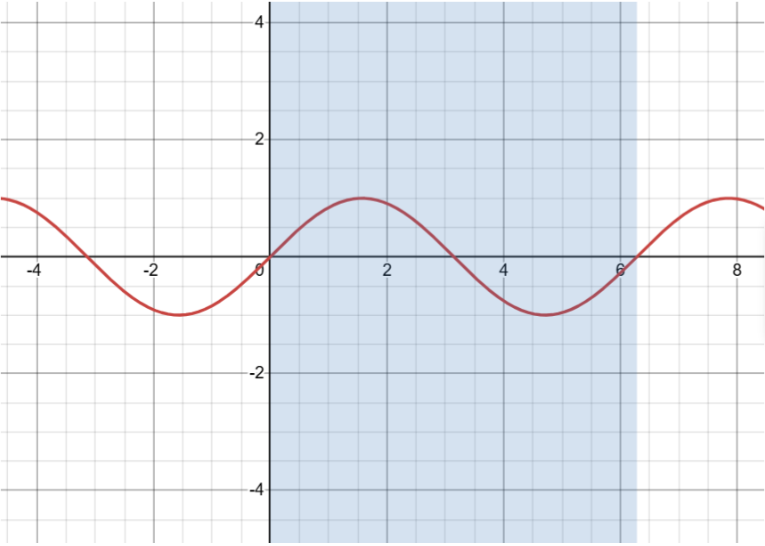
Our first thoughts might simply be the interval . It does cover the entire range of the graph, which is . However, notice that at the first bump when it goes down, it repeats the -values. This cannot be the interval.
You may or may not have noticed, but this is the best interval.
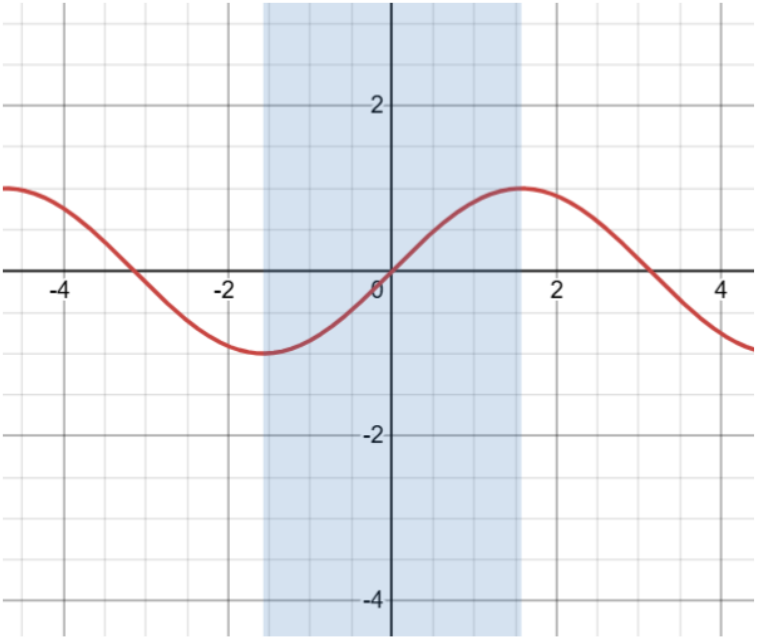
Notice how it immediately covers all the -values from to , and it doesn’t repeat any of the -values. This means that our chosen interval is the best interval we can use.
However, you may realize that this interval can be shifted over by to form this same best interval. What now? Well, the best thing to do is simply go with the simplest option, which is from
This interval is
Finally, we can bask in the beauty of our graph.
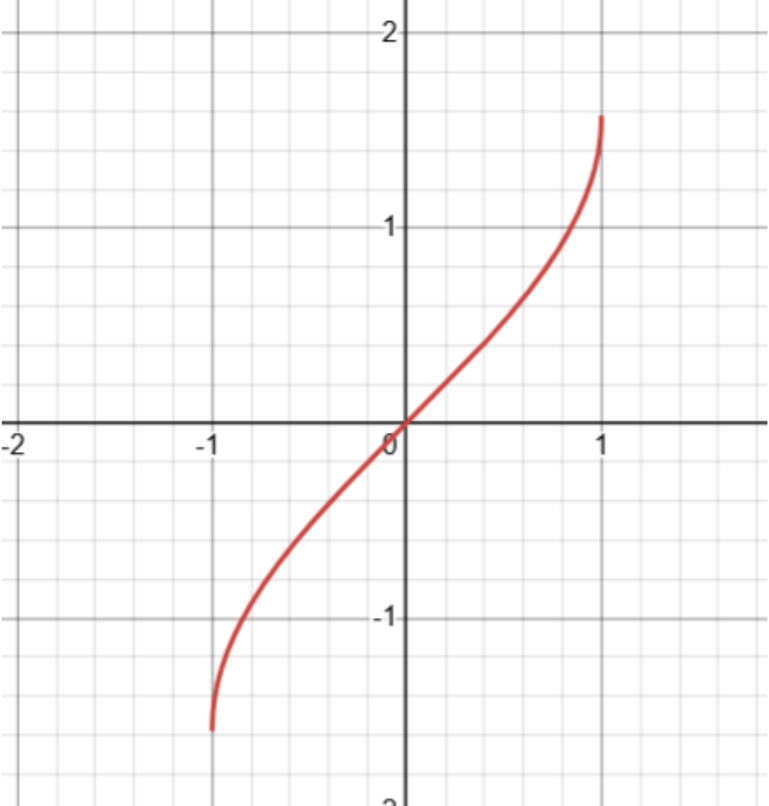
Notice that the range and domains are not exactly flipped. has a range , and you can see that corresponds with the domain of . However, the domain is clearly different, and that’s because we picked as our domain that we will work with to making the function actually happen. If we picked any other domain, it would have been harder to work with or cause -values to be repeated.
Now, “harder to work with” isn’t exactly the greatest answer, so what makes this certain interval so special? Well, if we go back to the unit circle, remember that we have degrees from to , and in radians, to . These are the values included in our first rotation. If we go backwards, we get to , and in radians, to . These are the values included in a rotation backwards. It would make sense for the range of the trigonometric function to be limited to the first rotation back and forth, since you can’t exactly work with degrees because that’s the same as degrees.
We can also limit this to just to , as this includes the full circle ( radians) without any overlap.
I just want to clarify that the domain of is , along with every other trigonometric function we will discuss. It is only that in the case of converting the function into its inverse, there has to be bounds otherwise the -values overlap and cause one input in to have an infinite number of different values, which is no good. In other words, has to pass the horizontal line test.
Inverse of Cosine
Using what we have learned, let’s go through what the inverse of is, another common trigonometric function. Remember that we cannot have -values be repeated, and our domain we limit the function to should be in the reasonable interval. Honestly, let’s just get visual!
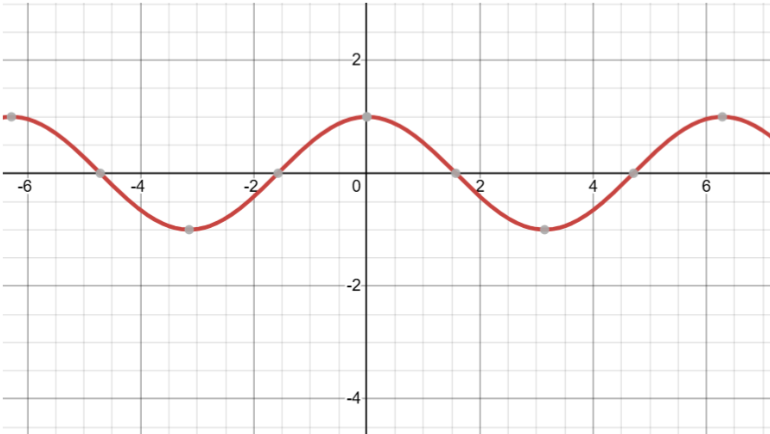
Take a moment to look at the function and see what interval will the function be able to cover the entire range without repeating any -values.
If you guessed , you would be bossily correct! However, you may realize that is also correct, and it does cover all the -values while also not repeating any of them, and it’s in our accepted interval. However, we will get into why you will see the first interval rather than the second in some time.
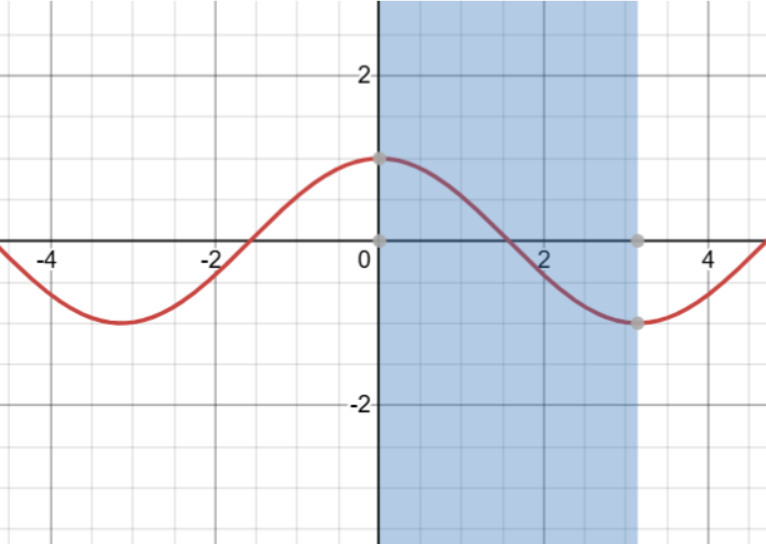
Anywho, let’s figure out the inverse function, or in other words, . For the normal cosine function, our domain is and the range is . This means that for , the domain is and the range is .
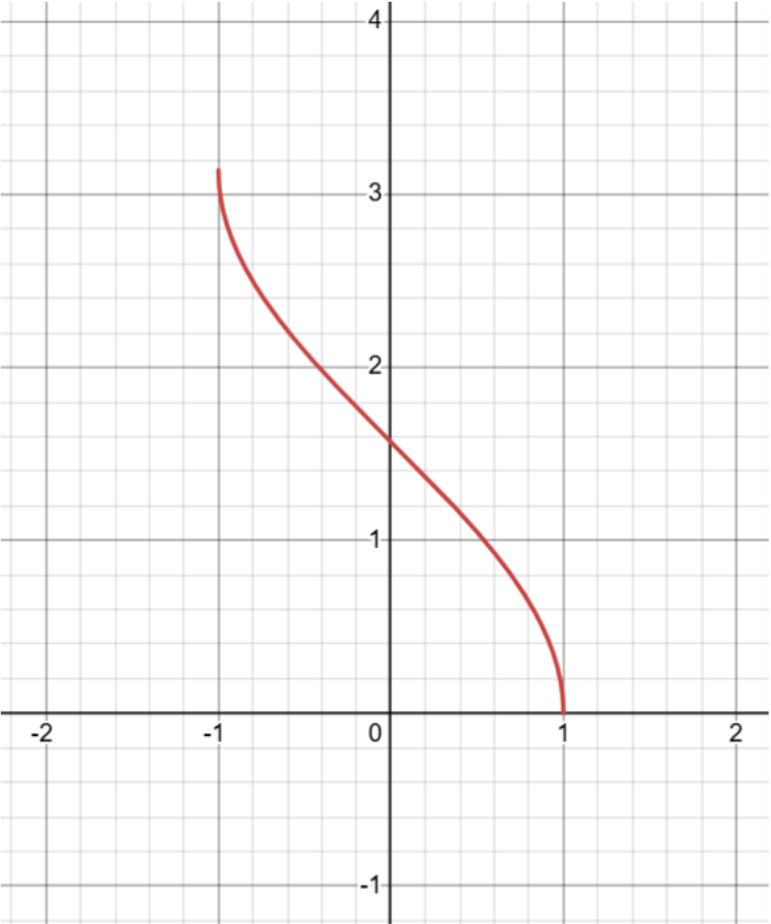
As promised, we will get into why the domain of or the range of isn’t in a later section.
Inverse of Tangent
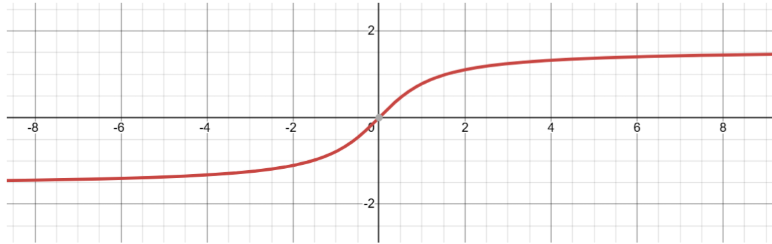
For , it’s a bit more interesting. I’m going to let the graph do the talking here.
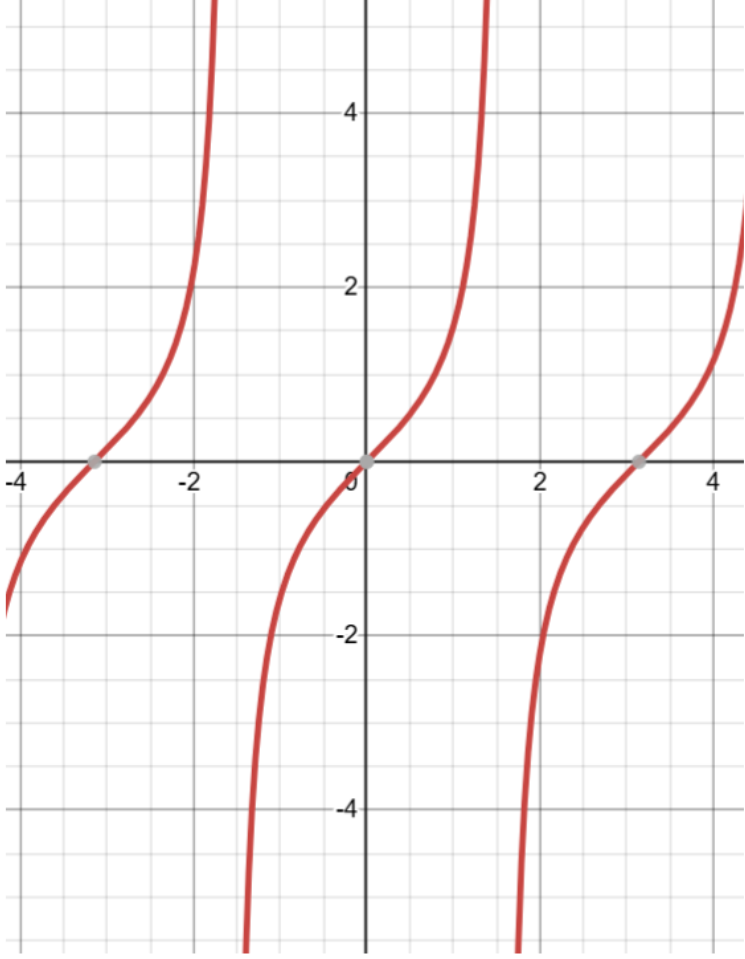
Notice how the range of the tangent graph is , so this means that we already know the domain of the graph is . What interval could have so that it doesn’t repeat any -values and covers the entire range? I think it’s easy to see that through its periodicity (repeating across intervals), the interval is .
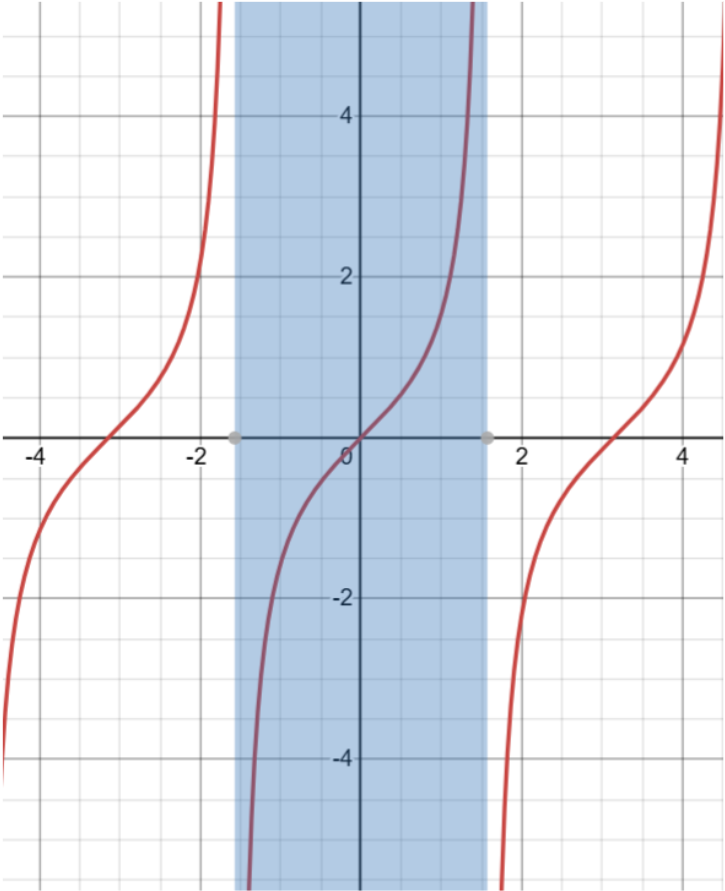
So if the graph has a domain of and a range of , the graph has a domain of and a range of .
Application of Inverse Trigonometric Functions
Inverse trigonometric functions actually have some use, and here we will answer why is unable to have a range of .
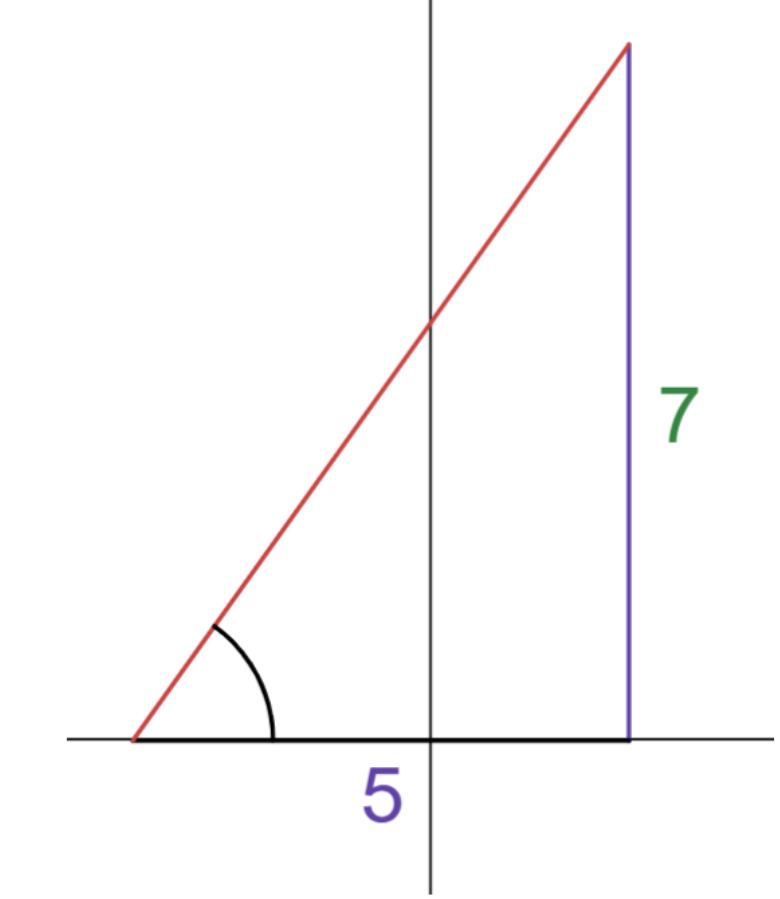
Let’s say we have a right triangle of side lengths 5 and 7 with an unknown hypotenuse length. If we calculate it using the Pythagoream theorem, we get
If we want to find the angle, we can use a bunch of different functions. For the purpose of this example, let’s use . This means that the angle is or . We can actually use the fact that to our advantage here, and take the of both sides so we have or . We can observe here that the purpose of the function including the other inverse trigonometric functions is to provide an angle when given the ratio of sides of a right triangle.
If these functions have to give out angles, it wouldn’t make sense for their range to be and spit out a negative angle, so we choose . It also just makes more sense mathematically.
However, what about ? It has a range of , and so it can technically output negative angles. However, it has a positive component and can output positive angles and still solve for the angle when given a ratio. In the case of , the ENTIRE range was in the negatives, and would not be able to give applicable real-world angles since angles are positive in real life.
Evaluating Inverse Trigonometric Functions
Now, we will have to figure out how to find the value of an inverse trigonometric function. If you were to receive and be asked to solve for , you would have to rely on memory to figure it out. In this case, it is degrees, or . Basically, this part is very memory dependent.
If you get the memory down, there is still one more hurdle you will need to pass. What exactly is the value of if ? This time, we will need to use right triangles.
If we were to plug in right now, we get , which already tells us a bunch of stuff. What exactly does mean on a right triangle? Well, we have to remember that the inverse trigonometric functions always give us angles. This means that we can equate , an angle in a right triangle to , or . This statement is currently not so meaningful to us, but if we take the tangent of both sides, we get . Now this is a more familiar form that tells us the opposite side is 15 and the adjacent side is 8 using the fact that . Using the Pythagorean theorem, , which means that .
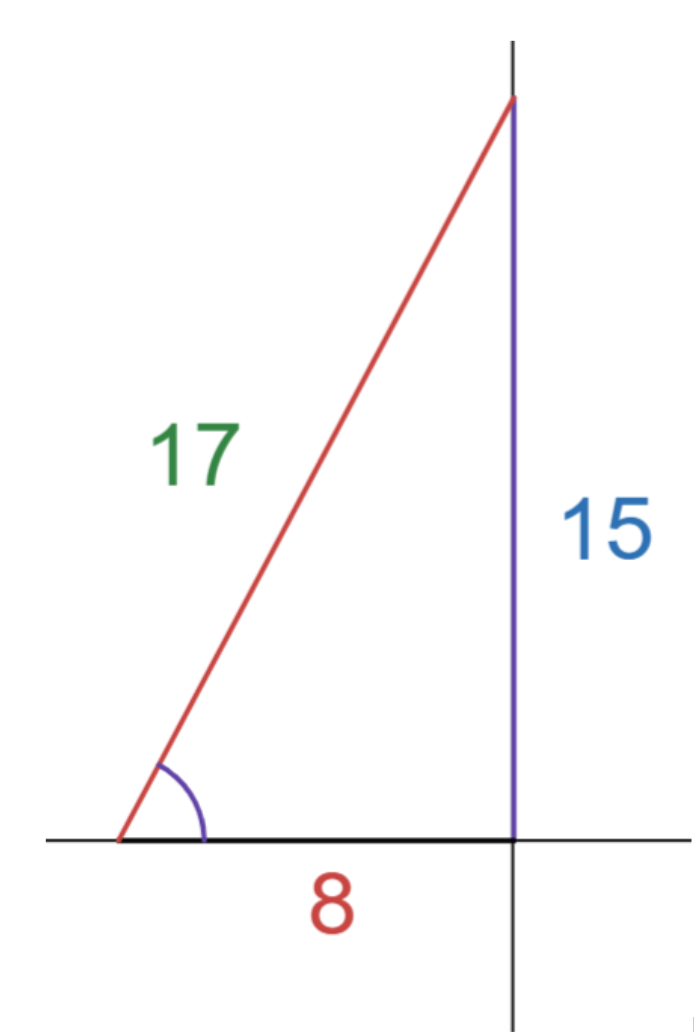
Now what? Well, we set and so we can just substitute that into our equation to get . To finally solve this, we will use the fact that . This means that
Notice how we inputted a ratio and got back a ratio. This is because turns the ratio into an angle, and turns the angle back into a ratio.
Just to review, the domain of is the same as the range of , and the range of is the same as the selected interval of that covers all the -values without repeating any. This applies for all the inverse trigonometric functions.
Domain: $@[-1, 1]4
Range:
Domain:
Range:
Domain:
Range: