
Introduction
Welcome back to AP Precalculus! In previous units, we explored different trigonometric functions and how they are used. In this article, we will focus on trigonometric identities and the methods used to solve trigonometric equations and inequalities. These tools help simplify complex expressions and make solving problems more efficient. Let’s get started!
Essential Knowledge from the CED
- Trigonometric equations and inequalities can be solved using different methods, including inverse trigonometric functions.
- Solutions found using inverse trigonometric functions may need to be adjusted because of domain restrictions.
- Since trigonometric functions are periodic, trigonometric equations often have infinitely many solutions.
- In contextual or real-world problems, the situation may imply a domain restriction that limits which solutions are valid.
Trigonometric Identities
In AP Precalculus, you will often need to rearrange and rewrite expressions in order to solve equations. In trigonometry, this is commonly done using identities, which allow you to rewrite a trigonometric expression into a form that is easier to solve. A trigonometric identity is an equation that is true for all values of within the domain of the functions involved. For example, the identity holds true for all real values of , regardless of the input.
Some important trigonometric identities to remember include:
- where x and are in the range
Proof of sin^2(x) + cos^2(x) = 1
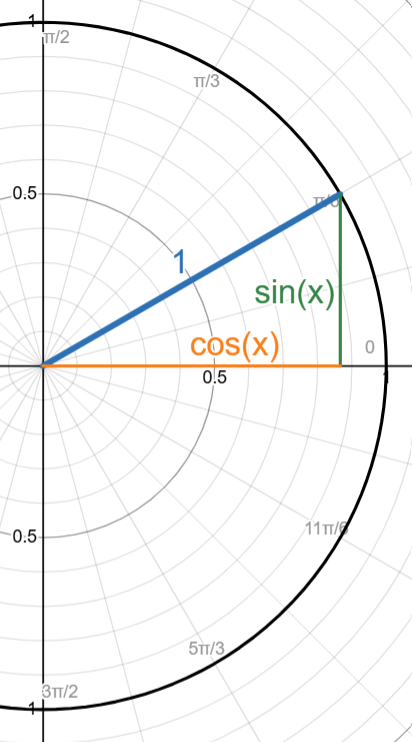
Consider the unit circle. Any right triangle inscribed in the unit circle has a hypotenuse equal to the radius, which is 1. The horizontal and vertical legs of the triangle correspond to and , respectively.
The Pythagorean Theorem states that the sum of the squares of the lengths of the legs of a right triangle is equal to the square of the hypotenuse. Applying this to the unit circle gives , which simplifies to .
These identities can make simplifying trigonometric expressions much easier. Consider the following expression:
At first glance, it may seem like a graphing calculator is needed, but this expression can be simplified using trigonometric identities.
Start with the denominator. Although is not listed directly, it can be derived from the identity . Adding 1 to both sides gives , so the denominator simplifies to .
Next, look at the numerator. Using the identity , subtract from both sides to get . This allows the numerator to be rewritten as .
The expression now becomes . Since , = . Dividing by is equivalent to multiplying by , giving the final simplified expression:
This is the most simplified form using AP Precalculus identities.
Trigonometric Addition Identities
For AP Precalculus, it is important to know the angle addition identities for sine and cosine:
You may also encounter double-angle or difference expressions on the exam, such as or . These can be derived directly from the angle addition identities, so memorizing those two formulas is especially useful.
These identities are helpful when simplifying expressions that involve multiple trigonometric functions. For example, consider the expression:
Since can be written as , the sine addition identity can be used to expand :
Combining like terms gives:
Dividing both the numerator and denominator by cos(x) simplifies the expression to:
Now that we understand how to manipulate trigonometric expressions, we can move on to solving trigonometric equations and inequalities.
Solving Trigonometric Equations
Trigonometric identities allow us to solve more complex trigonometric equations by simplifying expressions and recognizing equivalent forms.
When solving trigonometric equations, there are multiple methods you can use. One approach is to simplify one side of the equation, usually the more complicated side, until it matches the other side. Another approach is to manipulate both sides of the equation until they share a common expression. The method you choose depends on the structure of the equation, though simplifying one side is often effective when the other side is already in a simple form.
Consider the following equation:
There are two possible strategies for solving this equation: manipulating one side to match the other or manipulating both sides. In this case, the right side of the equation is already simplified, so it makes sense to focus on simplifying the left side.
A useful strategy when working with trigonometric equations is to look for identities that reduce complexity. In this expression, we can recognize the identity
Using this identity allows us to simplify the numerator, rewriting the equation as:
At this stage, it may seem possible to cancel the in the numerator and denominator. However, this is not valid because is not a factor of the entire numerator. It appears only as one term, so cancellation is not allowed.
Instead, we can apply another trigonometric identity. The expression matches the Pythagorean identity:
Substituting this identity into the equation gives:
Finally, we simplify the fraction on the left. Since , the left side simplifies to . This confirms that the left side and right side of the equation are equal, successfully verifying the equation.
Trigonometric Inequalities
Consider the following expression:
SOLVE FOR ALL SOLUTIONS IN THE RANGE
Similarly to the previous example, we can use identities to solve this inequality.
First, notice that we can factor out the coefficient of 4 on the right side.
Now, let’s simplify this expression using our identities. Off the bat, we can see two identities
We can simplify this expression to get a much simpler expression.
While you could attempt to solve this problem as it is, it would be tedious. Instead, we can try to simplify this into something that we do know, such as a single trigonometric function.
From here, we can reference the unit circle to get an idea of for which regions does our final inequality hold
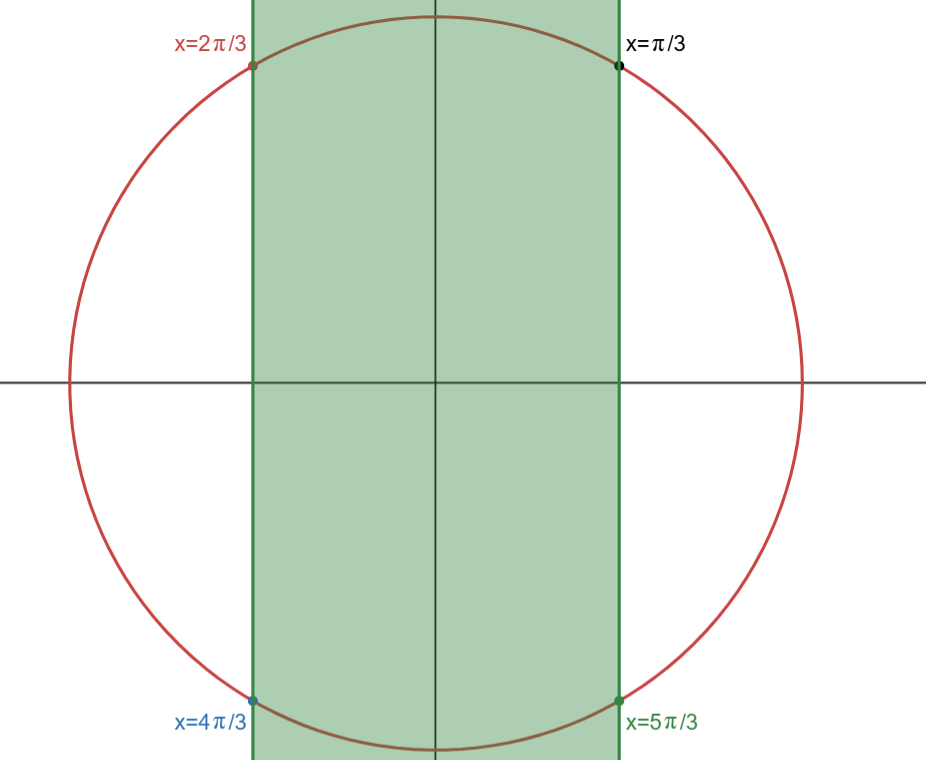
Our final answer is that x satisfies the equation for all sets ).