
Introduction
Welcome back to AP Precalc! Today we’ll be discussing the secant, cosecant, and cotangent functions. Over the past unit, we’ve been primarily discussing three main functions: , , and . In this topic, we’ll be discussing three new functions that are the reciprocal of these functions. We’re almost done with trigonometry, so hang in there while we soar to the finish. Without further adieu, let’s get started.
TL;DR
We go into a lot of depth in this article, but not all of it is necessarily required for the AP exam. If you want to get the key takeaways from the article that is needed for the exam, a summary is provided at the bottom of the page.

Secant
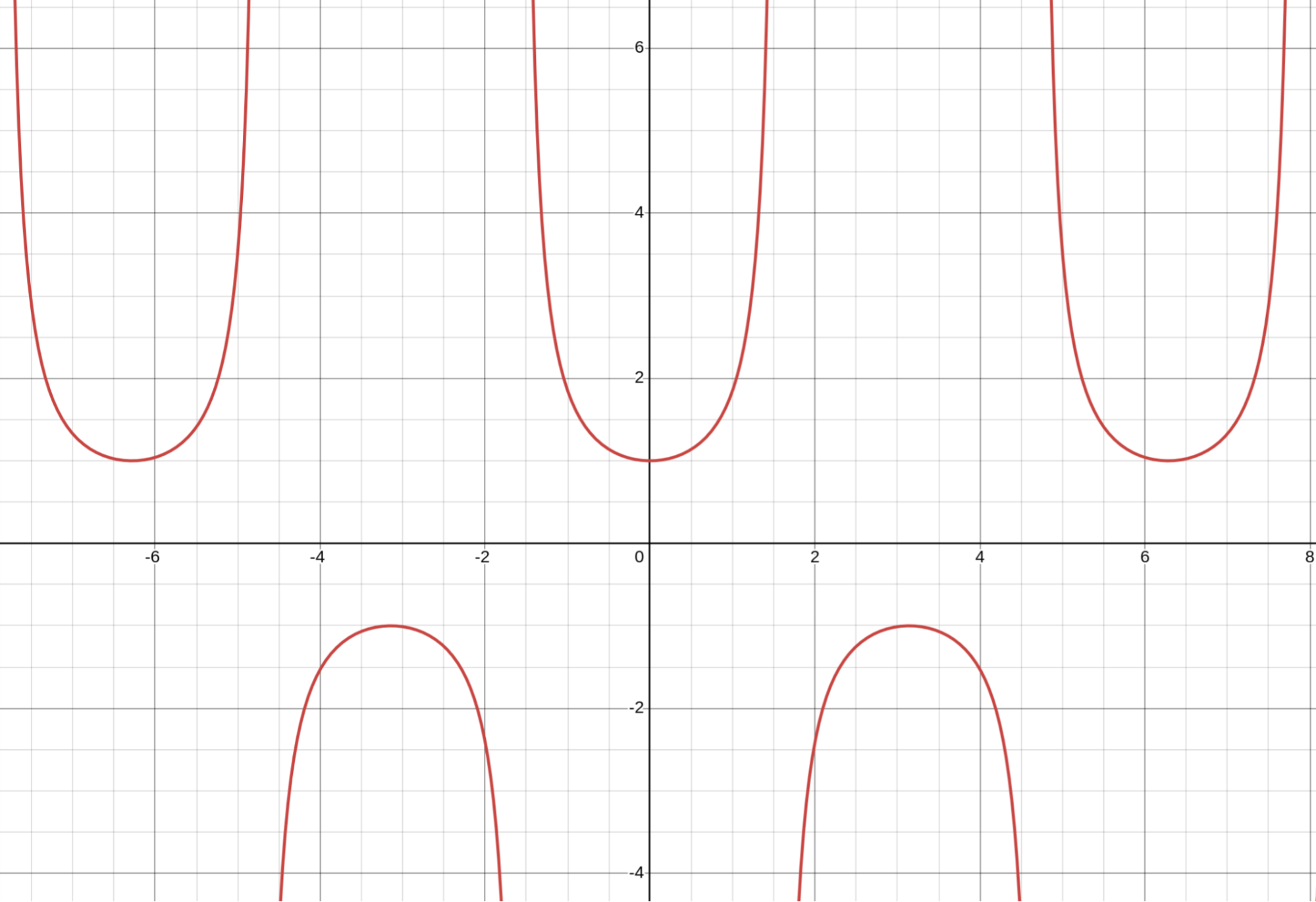
The secant function is equal to the reciprocal of the cosine function. In other words, .
Domain
Since , is defined for all values where \cos(\theta) is both defined and not equal to zero, as if , which is undefined. is defined for all real values of \theta, so our only concern is when . Referring to our unit circle, we can see that when , where is an arbitrary integer.
Range
The range of , or in other words, all values of \theta where or . can’t be greater than -1 and less than 1 because in order for that to be the case, would have to be greater than 1 or less than -1, which is outside of the range of . If you don’t understand, think about it like this. The cosine function goes from to and oscillates between those two numbers. If you replace with numbers from to into the secant function which is , you will notice that the value is never greater than -1 or less than 1. However, you may also notice that can be any other real number.
Cosecant
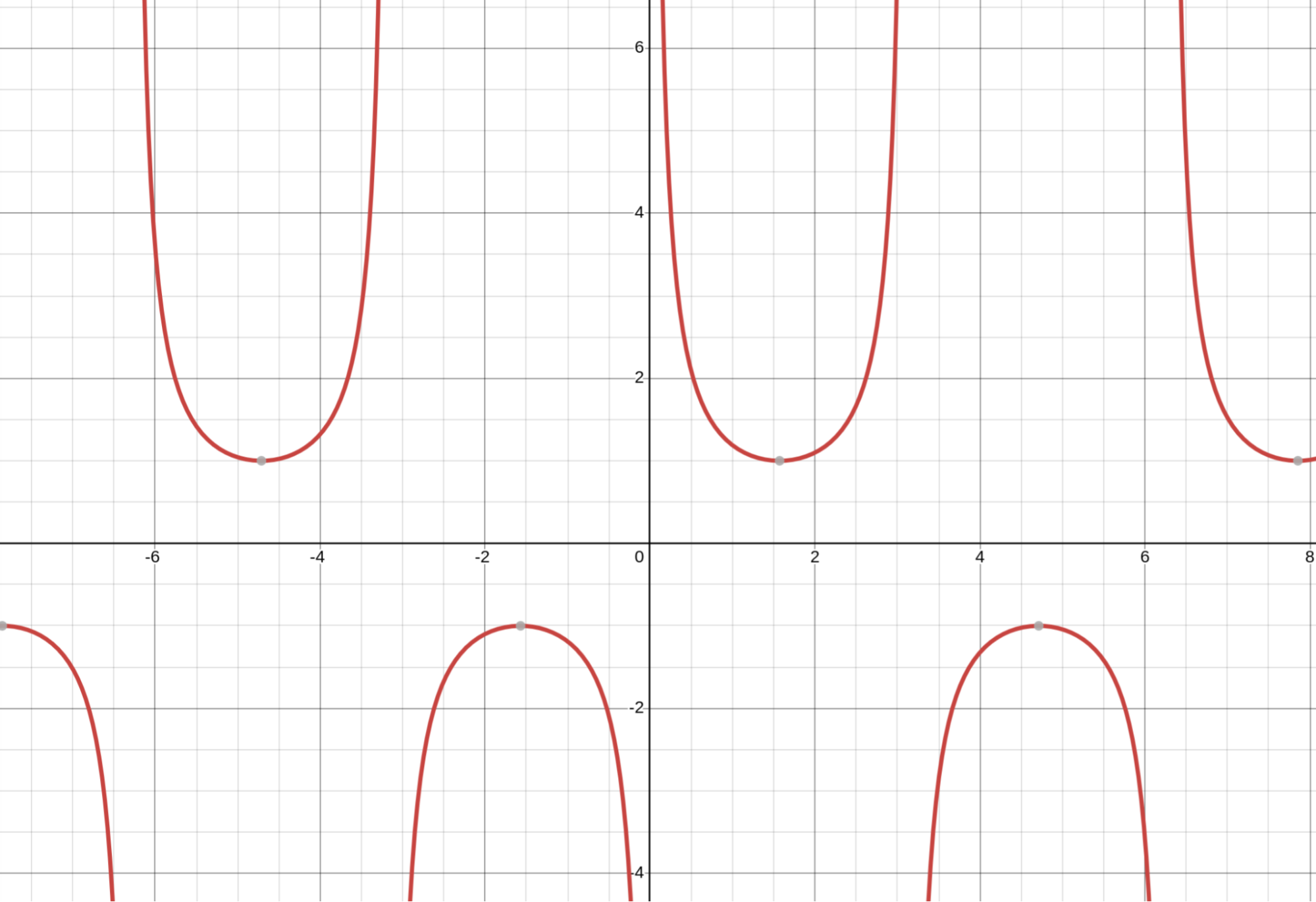
The cosecant function is equal to the reciprocal of the cosine function. In other words, .
Domain
Since , is defined for all values of where is both defined and not equal to zero, as if , which is undefined. is defined for all real values of \theta, so our only concern is when . Referring to our unit circle, we can see that when , where is an arbitrary integer.
Range
The range of . Since the range of is , has the same range as , and also for the same reason. The sine function oscillates between and , and so if we replace with numbers in between those two functions into the cosecant function , you will notice that we never gets values greater than -1 and less than 1, but we can achieve every other value.
WARNING
Even though cosecant feels like it should be the inverse of cosine, and secant should be the inverse of sine, it’s actually the opposite way around.
Cotangent
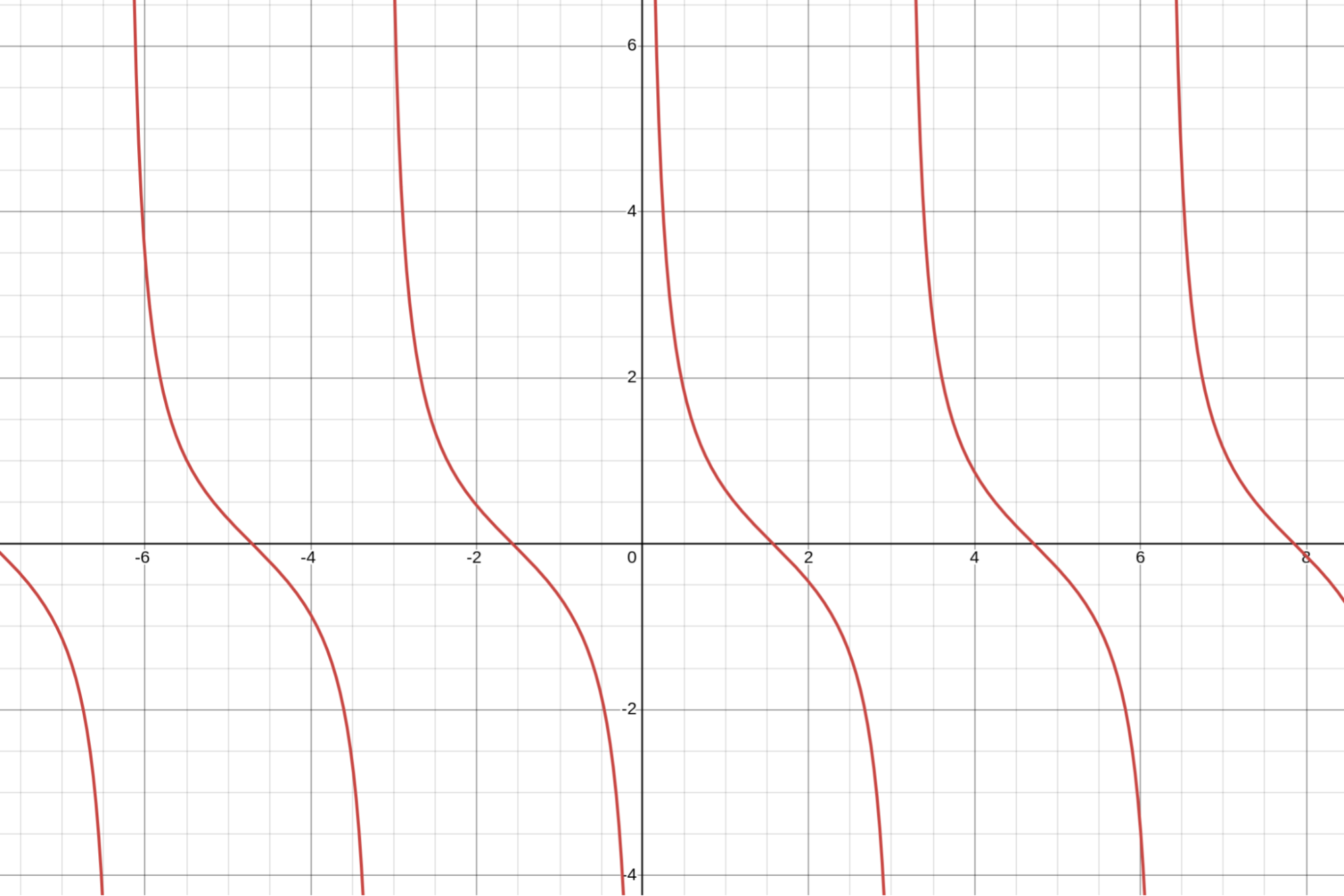
The cosecant function is equal to the reciprocal of the cosine function. In other words, or .
A special case
You might notice that these when , where k is an arbitrary integer. If we say that , then is undefined, since . However, if we say that , then . is formally defined as , so . For the rest of this lesson, we’ll be using , but excluding cases where , where k is an arbitrary integer, the two definitions are identical.
Domain
Since , is defined for all values where is both defined and not equal to zero, as if , . is defined for all real values of , so our only concern is when . Referring to our unit circle, we can see that when , where k is an arbitrary integer.
Range
Since can be all real numbers, can also be all real numbers, with the exception of 0. However, we’ve previously acknowledged that when , where k is an arbitrary integer, . Therefore, the range of is all real numbers.