
Introduction
Welcome to unit 3.13.! In this topic, you’ll learn how to determine the location of a point in the plane using both rectangular and polar coordinates.
The Polar Plane
Up to now, every function you have graphed has been on what is called a rectangular plane, or a Cartesian plane (if you wanna be fancy). However, polar functions are graphed on a polar plane, which has a different set of coordinate systems (when compared to the Cartesian plane). Instead of describing where a point is located with horizontal and vertical distances , it uses
: The directed distance from the origin (called the pole) to the point (it helps to think of “” as radius)
: The angle of rotation from the the polar axis (visually speaking, it would be the -axis, but it is not AT ALL similar to a Cartesian -axis whatsoever).
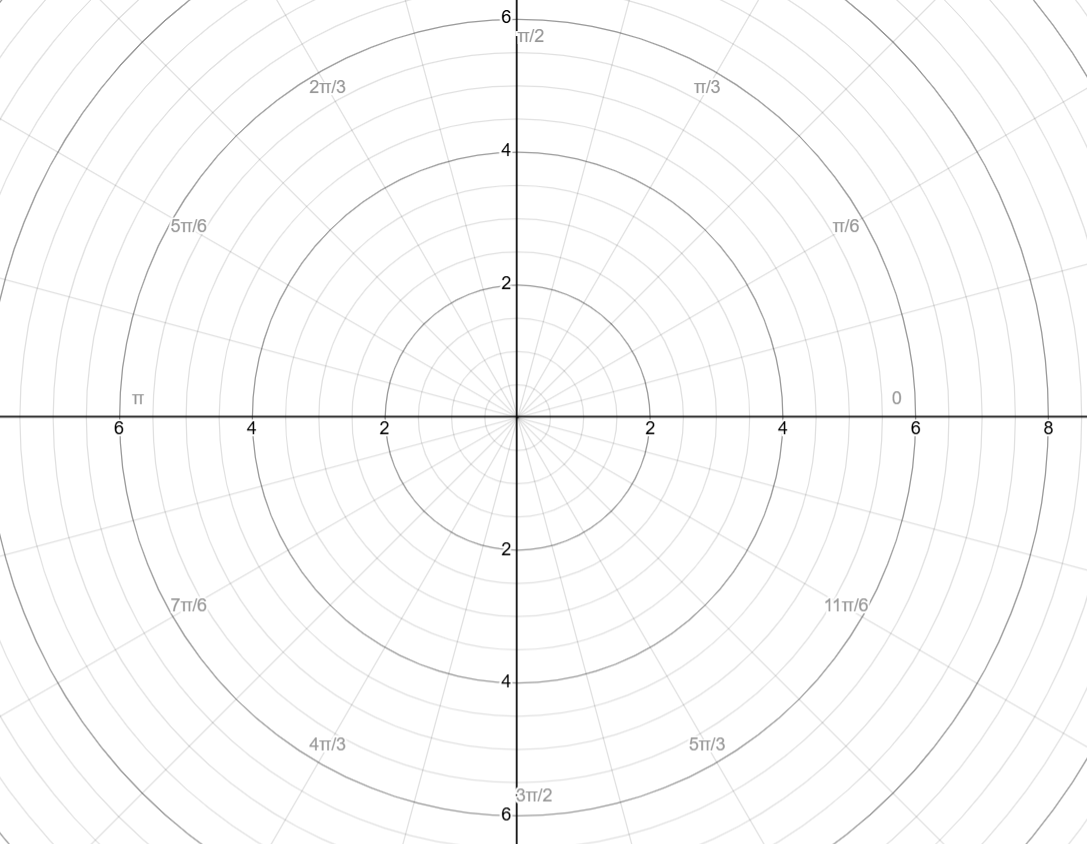
As you can see, the polar grid consists of concentric circles, each representing the magnitude “.” The “rays” depict the angle in radians.
Polar Points
A point has a radial coordinate (its distance from the origin/the pole) and angular coordinate (measured counterclockwise from the positive polar axis; similar to the unit circle)
In this example, the point is located at
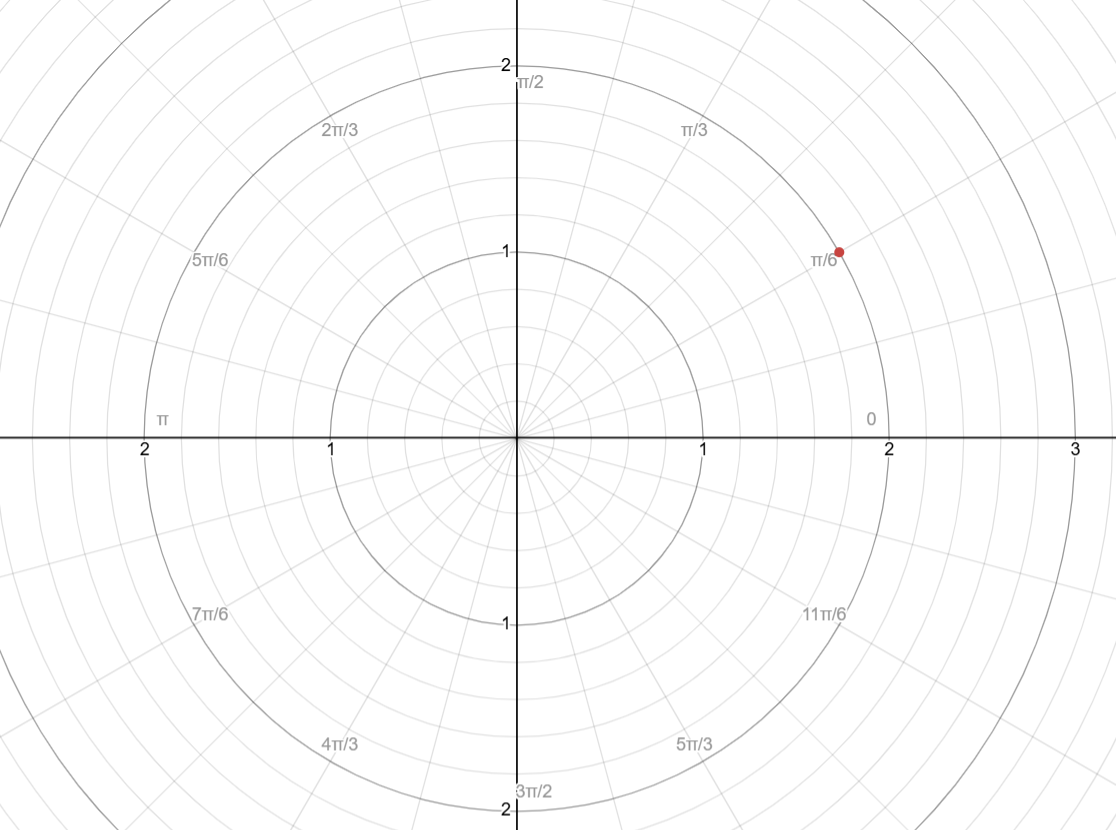
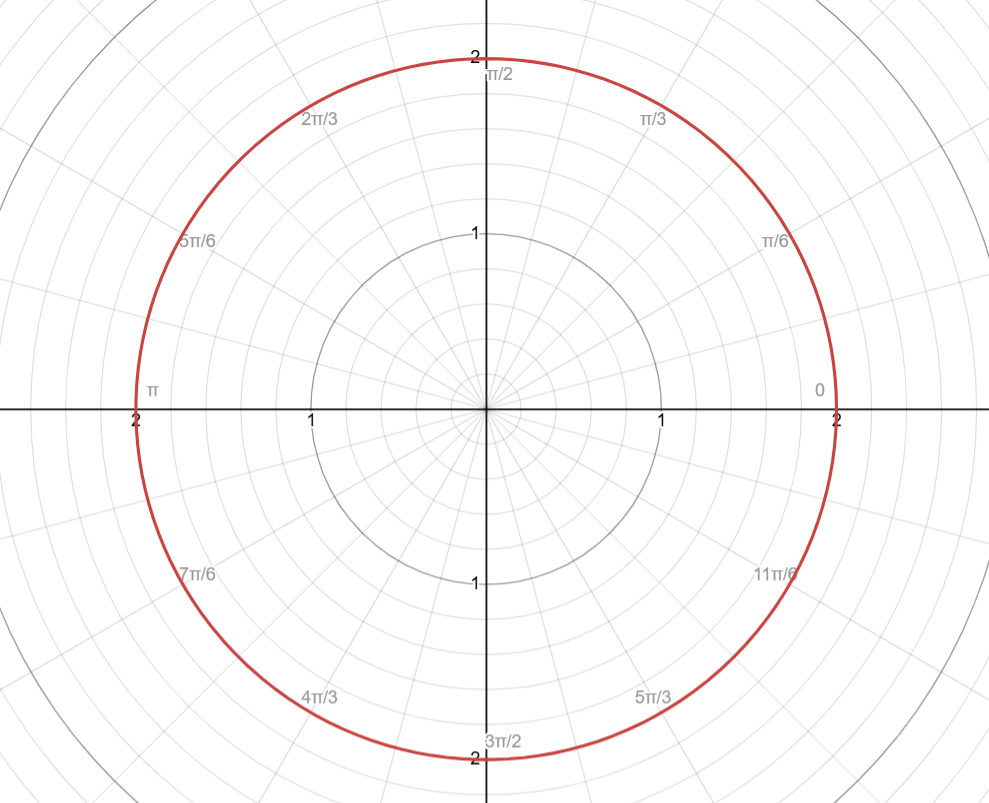
As you can see, the radius is of magnitude ,
(all points of can be represented by the following circle, a.k.a. the equation )
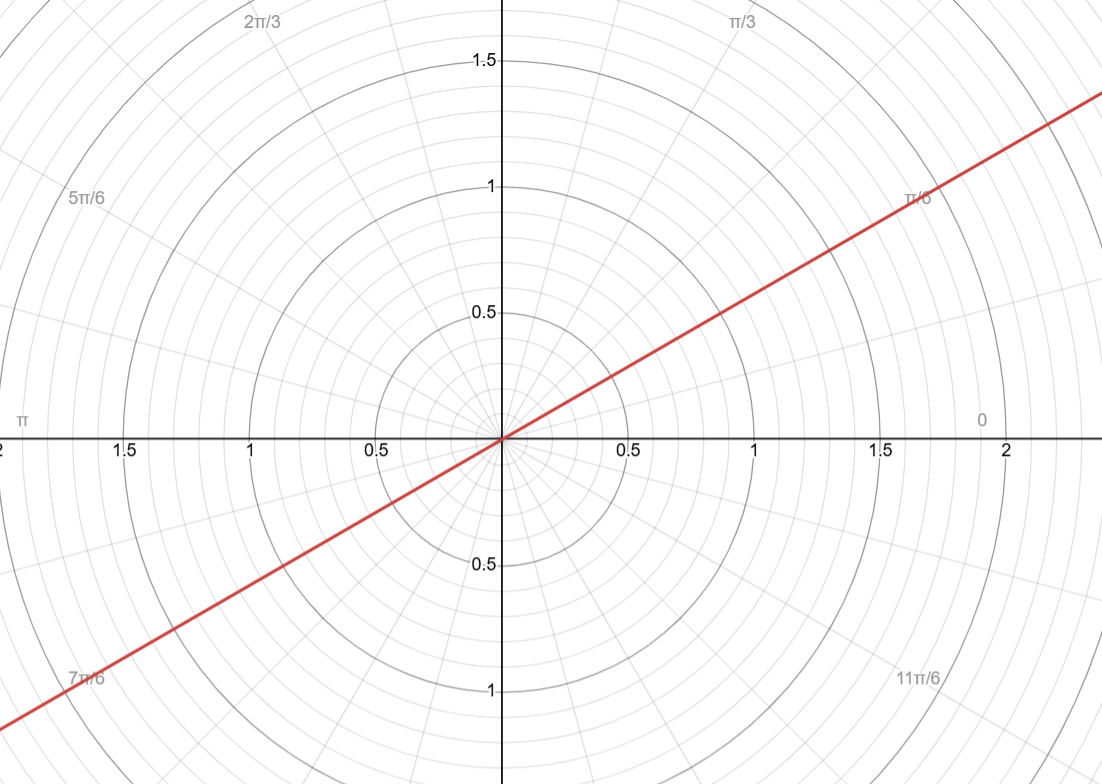
And the angle is
(all points of can be represented by the following ray, or the equation )
Equivalent representations of Polar Points
Unlike the coordinates of functions in the Cartesian plane, polar coordinates (and thus polar functions) are not unique. In the Cartesian plane, for example, the point means exactly one unique point. There is no other that gives that same point (when fully simplified).
But because angles and directions can be written in an infinite number of ways, a single point on the polar grid can have infinitely many polar coordinate pairs, meaning, there are an infinite amount of ways of representing the same point.
Let’s say I had the point
To express this point with another , I could add or subtract by . Remember that when you learned about the unit circle, an angle is said to be co-terminal when the terminal sides of the angles point towards the same point. You can find other co-terminal angles by adding or subtracting by .
Thus, on a polar graph, the point will have the same location as, say or . To represent all forms of (where we only change ), we can write:
This can be extended into the general form,
We can also represent the same point by changing both and . To do this, we must first understand what happens when you have a negative radius .
In polar coordinates, is the distance from the origin. If , you go out from the origin in the direction of .
However, if , you go the same distance but in the opposite direction of .
So for the point , the point would look like so:
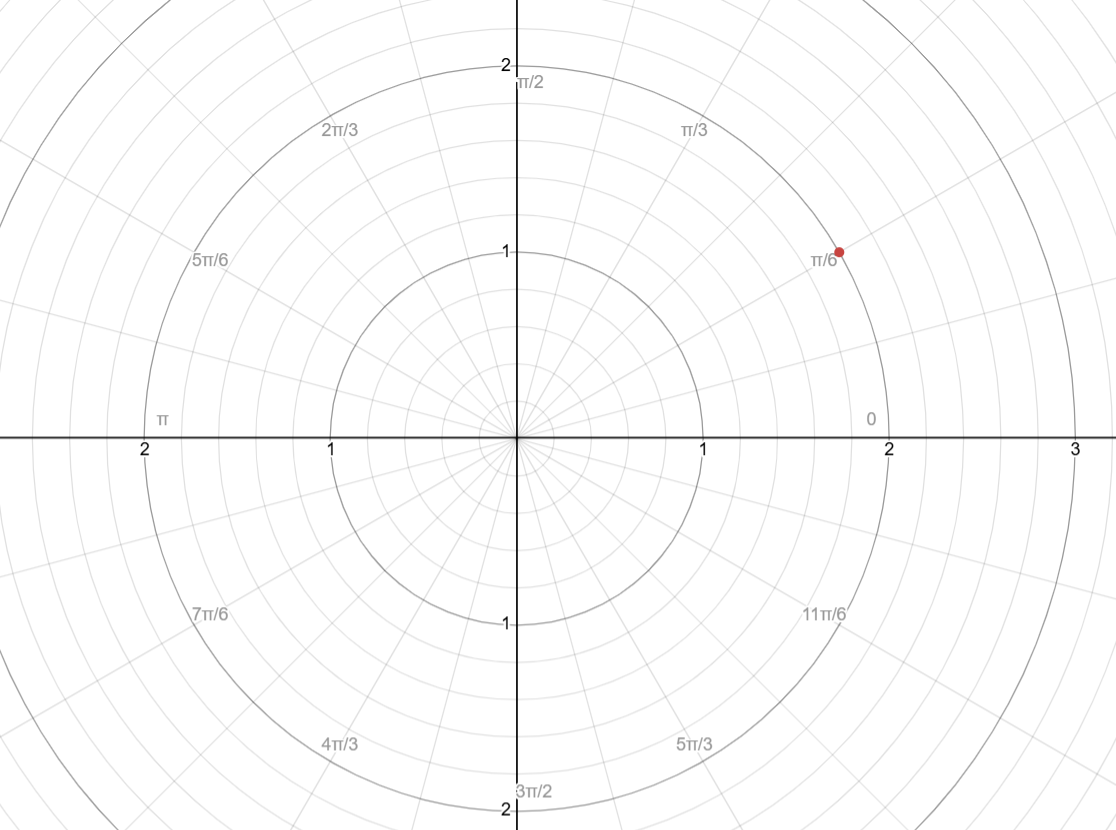
And for
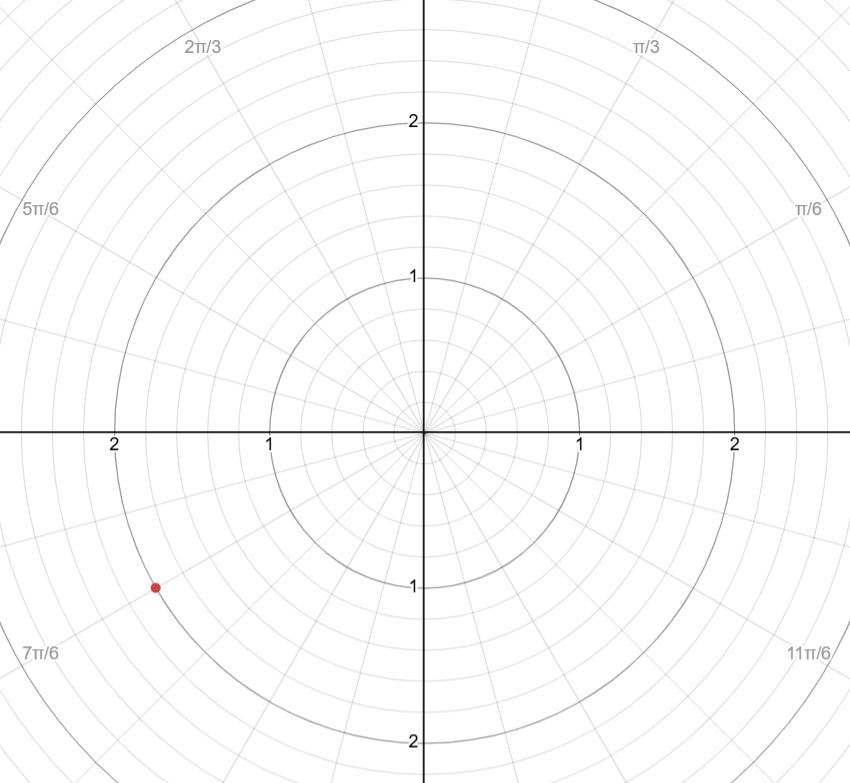
Now, knowing this, we can understand how a polar coordinate with a positive radius can be turned into an equivalent coordinate with negative radius. The process to do so is given by the following expression:
or, alternatively, we can express it as
Both can be explained rather clearly.
Take . First, we are flipping the radius, meaning we essentially perform a on the point. Then, we add a to our , meaning our angle has also ’d. So, essentially, our point has ’d twice, meaning it is back to its original state. From there, we can add or subtract any number of ’s, since adding to any angle creates a co-terminal angle.
Essentially, the formula is saying “Flip the radius, rotate by , and optionally keep adding full circles to get all the same points.”
And for , I’d like to direct your attention to in specific. Remember, , meaning can be any integer. , which means two times any integer, will always result in an even number, no matter what is. This is true for all values of . Then, we add one, meaning all values of are odd numbers, since any even number plus one turns odd. Thus, we are essentially multiplying an odd number with , then adding it to our angle . This has the same effect as the first, where we add a to first and then keeping adding , but it may make more sense to some.
In the end, whichever variation of this general form you choose to remember is up to you; you should preferably remember whichever one you believe is more intuitive.
Converting Between Polar and Rectangular Coordinates
When doing higher-level maths (like Calculus) and even some problems in Precalculus, converting Polar points to rectangular points makes solving the problem much simpler.
To understand why we’re able to do this, let’s break down what a polar point is. Take any polar point, .
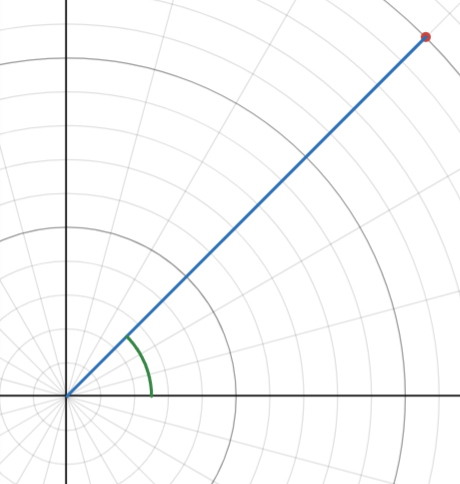
The segment (blue line) has a length and forms an angle with the polar axis or -axis (green angle).
If you draw the perpendicular from the point to the -axis, you form a right triangle
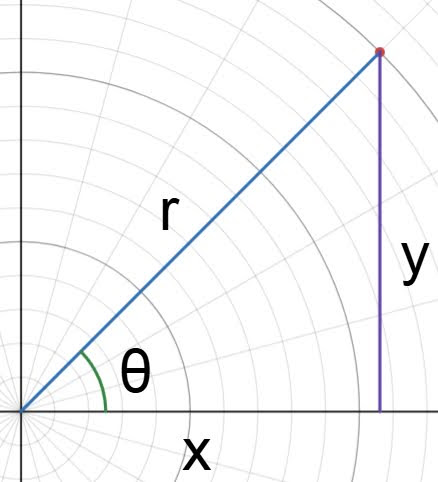
Now, it’s just some basic trigonometry.
and
Solving for and :
and
This is the standard way to translate any polar coordinate into its rectangular form.
Now, we must do it the other way around: we must convert rectangular points into polar points.
Similarly, let’s first investigate the components of a regular rectangular point, .
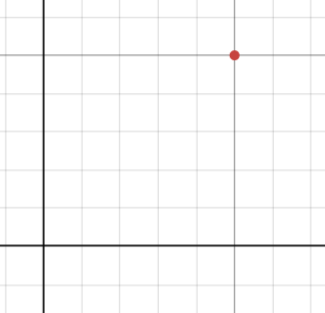
If you draw a line from the origin to that point, you’ve formed a right triangle:
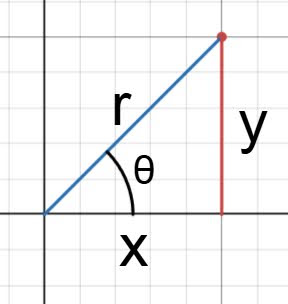
Now, we can do some basic algebra and trig:
(by the pythagorean theorem)
And,
(note, is the same as . It does NOT mean . Collegeboard typically uses )
Quadrant Considerations
To illustrate an issue, let’s do a quick practice problem:
Convert the point into polar coordinates.
First, we must find : this is the most straightforward step.
Now, before we find the angle using , we must remember how the arctan function behaves. Arctan has a range of . This means, no matter what value we put in as the input, we will always receive an output from that range. This matters because it implies that the output of arctan is only between angles , or in other words, it can only represent angles in Quadrants I and IV. Take a look at the unit circle; the interval can be shown as:
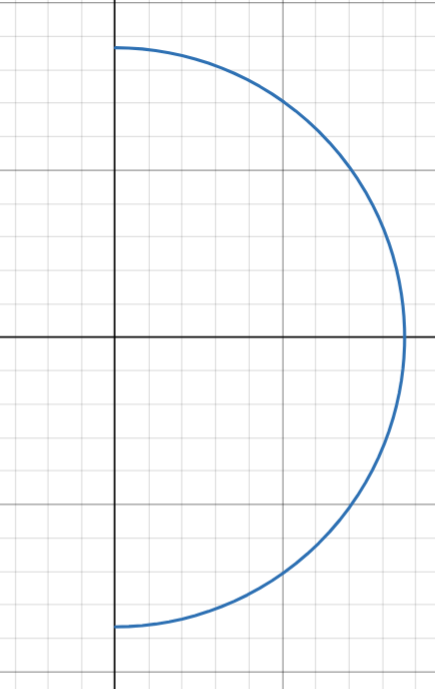
As you can see, it only covers Quadrants I and IV.
Thus, if the original rectangular point is in Quadrant I, works directly (it is the correct angle).
And if the point is in Quadrant IV, you’ll get a negative angle (which is technically fine, but the question will likely ask for the angle to be in the range of , so you’d just add a usually), which also works directly
However, if the point is in Quadrant II or III, will still give you an angle between , a.k.a an angle that points towards QI or QIV, which does not reflect the actual direction of the point. So, you will have to add a (and maybe adjust by a few 2’s appropriately) to find the true angle in those quadrants.
The reason why adding a works is because of tangent’s intrinsic behavior (its period is ).
Remember, . In QI, both sin and cos are positive, so it still comes out to tan(x), and when in QIII, both sin and cos are negative and thus become positive (since the two negatives cancel each other out). Notice, angles in QI can be turned into angles in Q3 by adding/subtracting by
This is why tangent has equal values when the angle is in the opposite quadrant.
So, when you add a to your angle from , it does not change the value since you are not changing the ratio of . However, it does alter the direction of the point.
This may be a bit hard to understand, so let’s complete the problem.
is an angle that points in the direction of the first quadrant. However, the coordinate is in the third quadrant. Thus, to get angle into the third quadrant, we must add (or subtract) a . By convention, we typically try to have our default angle in the range of , so let’s add a , which gives us the angle .
Thus, our angle is .
Now, we can find our polar coordinate.
Our is and our angle is . Thus, our polar coordinate is:
Here’s a challenge for you: find the two forms you can use to express all variations of the polar point . The answer will be at the bottom of this article.
Complex Numbers in Rectangular and Polar Form
A complex number is a number that has two parts: a real part and an imaginary part. It is written in the standard rectangular form as:
Where:
- is the real part, denoted by
- is the imaginary part, denoted by
- is the imaginary unit, defined by
- AND
Every complex number corresponds to a point in the complex plane:
- The real part determines the horizontal position (-axis)
- The imaginary part determines the vertical position (-axis)
Thus, the complex number can also be represented as the point in the plane.
A complex number can also be expressed using polar coordinates :
- is the distance from the origin (called the modulus)
- is the angle with positive real axis (called the argument)
In polar form, the complex number is written as:
Where:
, (with quadrant adjustments)
Example:
The point has:
,
So, the polar form is
Practice:
- The point P is given in polar form as
- Part A: Give a representation of P that use a positive radius
- Part B: Give a representation of P that use a negative radius
- Convert the rectangular point into polar coordinates. Write your final answer with exact values in the form with
- The polar equation represents a circle. Write its rectangular equation
- What polar equation would represent the vertical line ?
- Decide whether the following polar points represent the same location or different locations. Justify your answer.
- Part A: and
- Part B: and
- A polar coordinate of a point is given as
- Part A: Convert it into rectangular coordinates
- Part B: Without calculating directly, predict a Cartesian representation of the point (Hint, maybe some sort of reflection?)
- Find the polar form of the rectangular point
- Part A: Compute
- Part B: Determine
- Part C: Is adding a necessary? If so, is there another way of getting the same result?
- Express the complex number in polar form . Be precise about ’s quadrant, then show two other equivalent polar forms of .
- Suppose two points are given: and
- Part A: Convert both into rectangular form
- Part B: Do they represent the same point? If not, what is the distance between them (hint: use the rectangular form to find out)?
Answer Key
Challenge
Find the two forms you can use to express all variations of the polar point .
For this question, we can just plug and chug.
For a negative :
OR
OR
PROBLEM #1
The point P is given in polar form as
Part A: Give a representation of P that use a positive radius
Similarly, we can also plug and chug.
Plugging in,
Part B: Give a representation of P that use a negative radius
OR
OR
PROBLEM #2
Convert the rectangular point into polar coordinates. Write your final answer with exact values in the form with
First, we must find
Then, we can move onto finding
This basic arctan value is negative (located in QIII, to be exact), but the point lies in Quadrant II, so we must add a
Thus, the answer is:
PROBLEM #3
The polar equation represents a circle. Write its rectangular equation
If you’re astute, you’ll have realized that we can just use the circle formula for this.
However, you could also substitute :
PROBLEM #4
What polar equation would represent the vertical line ?
Since , the line is:
(by substituting )
PROBLEM #5
Decide whether the following polar points represent the same location or different locations. Justify your answer.
Part A: and
Let’s start this problem by applying the basic formula for a negative :
turns into
Now, we can just start adding an odd number of 's
Thus, the point is
Meaning the points are indeed the same.
Part B: and
Here, we can simply subtract/add by .
Let’s try subtracting by .
So the point can also be represented as
Thus, they represent the same point.
PROBLEM #6
A polar coordinate of a point is given as
Part A: Convert it into rectangular coordinates
Here, we just need to solve for and to find the rectangular coordinates.
Thus, the point is
Part B: Without calculating directly, predict a Cartesian representation of the point (Hint, maybe some sort of reflection?)
Let’s think about this: usually, when we turn negative, we add or subtract by a to effectively “cancel out” what effect the negative had. In this way, a negative can be seen as the same thing as rotating the ray by (), at least in the manner that the graphical result is the same.
Rotating a point by about the origin is the same as reflecting a point across the origin. So, if we apply some Algebra 2/geometry rules, we know that reflecting a point across the origin yields the point . Thus, using our previous answer , we know that our new answer will be .
PROBLEM #7
Find the polar form of the rectangular point
Part A: Compute
Part B: Determine
The point is in QIII, but will give a point in QI, so we must add a .
.
Part C: Is adding a necessary? If so, is there another way of getting the same result?
Yes. Without it, our point would be in the wrong quadrant. We could also flip the sign of , or subtract by .
PROBLEM #8
Express the complex number in polar form . Be precise about ’s quadrant, then show two other equivalent polar forms of .
Because really just acts like a unit, we can treat as point
This is an angle in QI, but is in Q3, so we must add or subtract by a
I will use
Note, there are other answers if you apply the polar equivalent point formulas.
PROBLEM #9
Suppose two points are given: and
Part A: Convert both into rectangular form
For point ,
Thus,
For point ,
Thus,
Part B: Do they represent the same point? If not, what is the distance between them (hint: use the rectangular form to find out)?
No, the points and do not represent the same point.
The distance between point and is , ( is for unit)