
Introduction
Welcome! We’re here with our first AP exam guide! This time we’ll be going over the MCQ questions you’ll see during the exam and how to go about them! We’ll talk about these in four broad categories: right before the test, general MCQ tips, during the non-calculator MCQ portion, and during the calculator MCQ portion.
Right Before the Test
Before entering the test, do the following.
- Breathe: Your nerves are bound to be sky high right before the test, and it is important to calm down so you can do your best.
- Go over the formula sheet: That resource was made for a reason, if you’re not feeling confident in something, just go over it real quick so you can knock out a question on it if it comes up during the test (Formulas Review). Note that the actual AP exam does not provide you with a formula sheet.
- Tell yourself you got this: “You studied as much as you could, and you are ready for this exam.” Additionally, this exam doesn’t define you, always remember that.
General MCQ Tips
- When going into this test, you will realize something quickly, the MCQs are often easier than what you saw in AP Classroom. This is normal, don’t overthink the questions.
- Just like any other math test, make note of what information you are given and what exactly the question is asking, whether that be through highlighting or mentally.
- Read the graphs carefully, it is really easy to mess up by flipping your and values or not reading the scale correctly.
- Think about what skills you are being tested on and use the formula that matches.
- Utilize the process of elimination to eliminate blatantly wrong answer choices.
- If you are stuck, graph it out. This especially goes for and functions.
- The harder questions in this portion are the real-world problems, read the question and reread if you don’t understand the scenario in the question.
Non-Calculator MCQ Tips
- This portion of the test lasts for 65 minutes and has 29 questions. Meaning that you are looking at around 2.25 minutes per question, which should be plenty of time.
- Understand the different transformations of your parent functions. Here is a PDF of the different parent functions that we got from the University of Wyoming. We cannot stress this enough, if you are missing questions on the non-calculator MCQ it's likely because you don’t understand how the function is graphed.
- Understand your exponent and log rules. This is also a very common reason students miss questions.
Example Non-Calculator MCQ with all tips utilized:
13. Iodine- has a half-life of days. In a particular sample, the amount of iodine- remaining after days can be modeled by the function given by , where is the amount of iodine-131 in the sample at time . Which of the following functions models the amount of iodine-131 remaining after hours, where is the amount of iodine-131 in the sample at time ? (There are 24 hours in a day, so .)
(A) ✖️
(B)
(C)
(D)
Credit to: AP Precalculus CED Page 145
- We highlighted the important information in the question.
- We can eliminate clearly incorrect options; in this question, A is clearly wrong because it simply ignores the part of the question.
- We know that , which means . Plugging that into the original question, we have:
- Apply formulas from the formulas review (specifically exponent rules). Looking at the answer choices, we know that the rule we are going to be using is the power of a power rule. The factors of are and , so the answer is D.
Calculator MCQ Tips
- The Calculator portion of the MCQ has 13 questions and lasts for 40 minutes. This means you are looking at 3.08 minutes per question.
- Make sure you are in radians mode on Desmos.
- The first step is to write the relevant equation from the question in Desmos after you utilize the general MCQ tips.
- A lot of the questions in this portion look at a specific interval, ensure that you are at the correct interval in Desmos.
Example Calculator MCQ with all steps utilized:
20. The temperature, in degrees Celsius (), in a city on a particular day is modeled by the function defined by , where is measured in hours from 12 P.M. for . Based on the model, how many hours did it take for the temperature to increase from to ?
(A) ✖️
(B)
(C)
(D)
Credit to: AP Precalculus CED Page 151
- We highlighted the important information.
- A is clearly wrong because the domain of is from to hours, meaning that the most hours between any two values is hours.
- Input the equation into Desmos and look at the necessary interval.
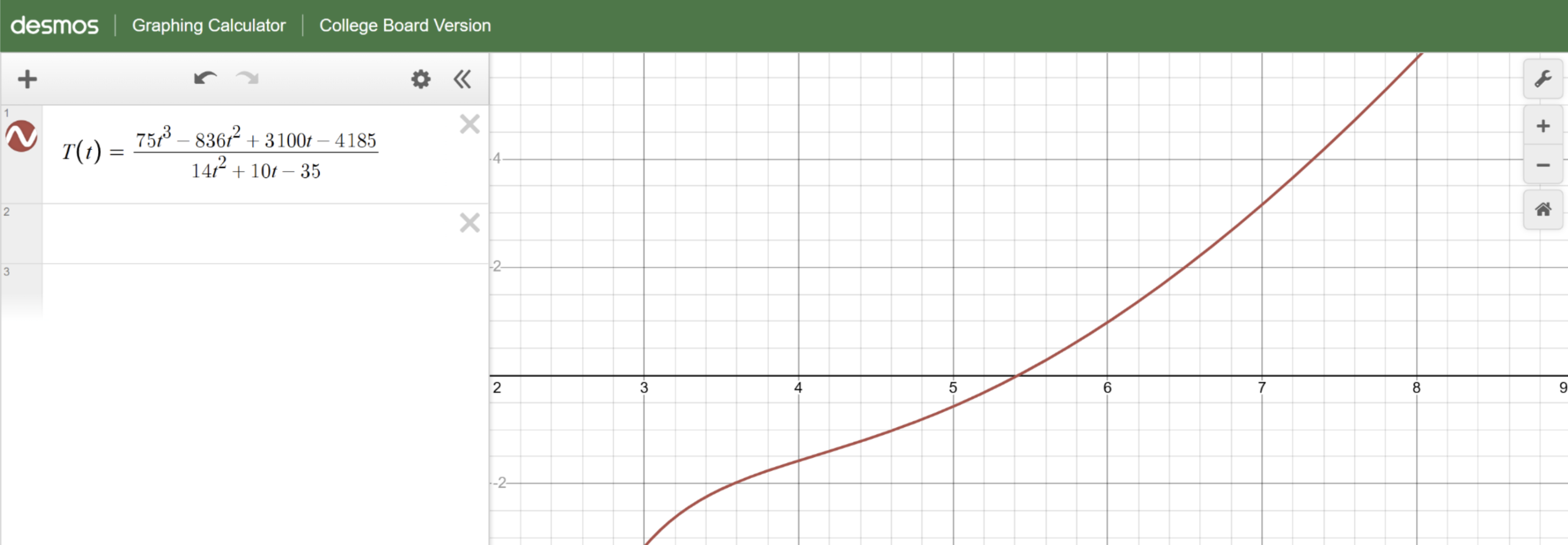
4. We can set the two values given by the question, and , and subtract the relative -values to get our answer.
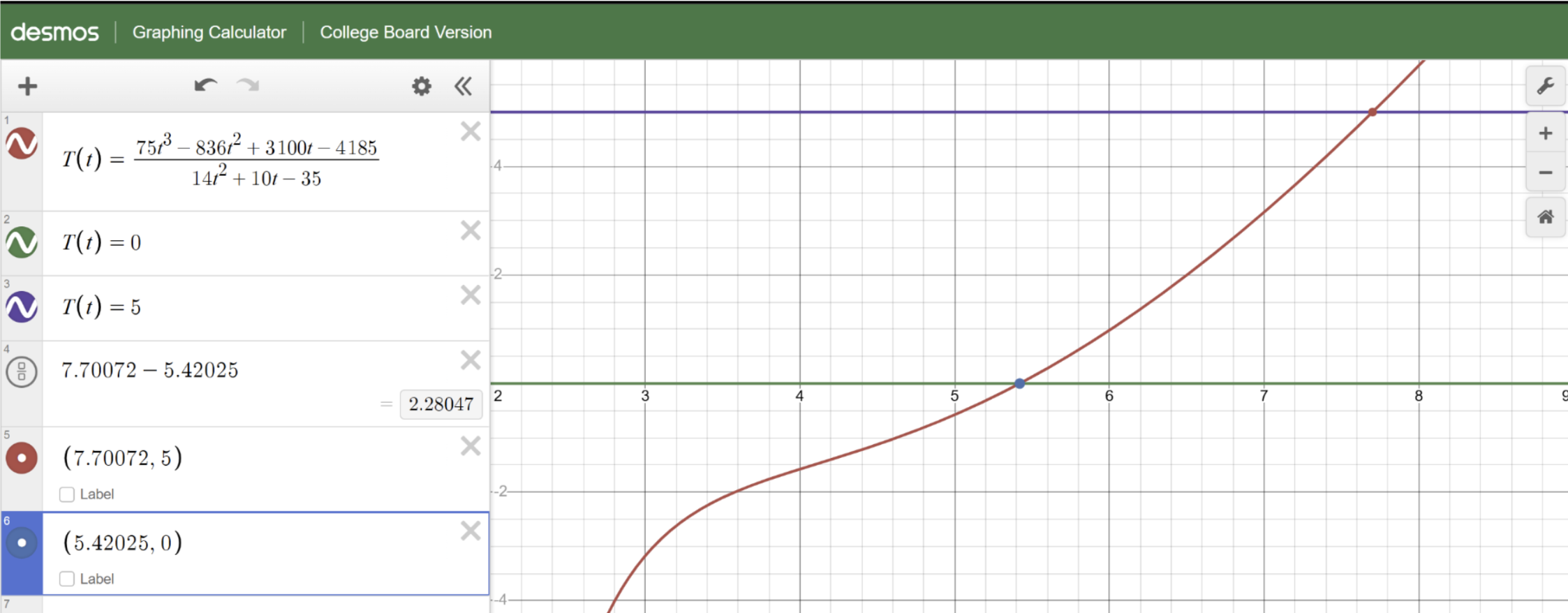
The correct answer is D.
That’s all for this guide! Good luck on the test!