
Introduction
Hello! This is a formula review for AP Precalculus covering the main formulas, identities, relationships, and connections from each unit. Everything here is worth knowing for the AP exam in May. Happy studying!
Unit 1: Polynomial and Rational Functions
Average Rate of Change (AROC)
where and represent the boundaries of an interval on the -axis.
Alternatively,
This formula measures the average change in the output for every one-unit change in the input. For a linear function, the average rate of change is constant and equals the slope.
See Unit 1.2: Rates of Change for more on this topic.
Difference Quotient
,
where represents the horizontal change in .
This is a specific form of AROC, where it is specifically the average rate of change from to .
The Quadratic Formula
For ,
.
The expression inside the square root is the discriminant:
The discriminant determines the number and type of real solutions:
- If , there are two distinct real solutions.
- If , there is one real solution.
- If , there are no real solutions.
See Khan Academy: Quadratic formula explained (article).
Vertex of a Quadratic
For , the -coordinate of the vertex is , and the corresponding -coordinate is .
Thus, the vertex is .
Vertex Form: , where is the vertex.
See Prepscholar: Vertex Form: What is it? How do you calculate it?
Factored Form of a Polynomial
(a.k.a. Linear Factorization Theorem)
A polynomial with zeros can be written as
, where is the leading coefficient.
If , then is a factor of .
See Unit 1.5: Polynomial Functions and Complex Zeros.
Remainder Theorem
When is divided by , the remainder is .
Here, is a constant number.
See Cuemath: Remainder Theorem
Binomial Theorem
=,
where .
The factorial is defined by , .
Here,
and are the first and second terms in the binomial, respectively.
is the Greek letter Sigma. It’s an operator (like plus and minus) that tells you to add all terms together.
is the term counter. It starts at zero and goes up by one until it reaches .
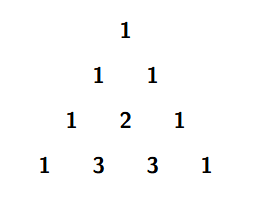
Alternatively, Pascal’s Triangle can be used to expand binomials of the form :
See Unit 1.11: Equivalent Representations of Polynomial and Rational Expressions
Rational Functions
For :
Holes (Removable Discontinuities): Occurs at where both and cancel out.
Vertical Asymptotes: Occurs at the zeros of the simplified denominator where .
Horizontal Asymptotes:
- If the degree of the degree of : .
- If the degree of the degree of : (ratio of leading coefficients, where is the leading coefficient of and is the leading coefficient of ).
- If the degree of the degree of : Slant asymptote found via polynomial division.
See Unit 1.7: Rational Functions and End Behavior
Limits and Function Behavior
Left-Hand Limit
: The value approaches as gets closer to from the left ().
Right-Hand Limit
: The value approaches as gets closer to from the right ().
Two-Sided Limit
If the left-hand and right-hand limits do not match, the limit does not exist (DNE).
Horizontal Asymptotes
If or , then the line is a horizontal asymptote.
End Behavior
Polynomial End Behavior is decided by the leading term :
Removable Discontinuities (Holes)
If a function has a hole at with coordinates , , even if is undefined.
Vertical Asymptotes
If , then is a vertical asymptote.
See Unit 1.6: Polynomial Functions and End Behavior
Unit 2: Exponential and Logarithmic Functions
Arithmetic Sequences and Linear Growth
- Explicit Formula:
- General Formula:
- Recursive Formula:
- Constant Rate of Change:
See Unit 2.1: Changes in Arithmetic and Geometric Sequences.
Geometric Sequences and Exponential Growth
- Explicit Formula:
- General Formula:
- Recursive Formula:
- Constant Proportional Rate of Change:
See Unit 2.1: Changes in Arithmetic and Geometric Sequences.
Exponential Functions
- Standard Form:
- Continuous Growth/Decay:
- Growth for all , Decay for all . Constant at .
See Unit 2.3: Exponential Functions.
Properties of Logarithms
Definition:
- Product Property:
- Quotient Property:
- Power Property:
- Change of Base Formula:
- Inverse Properties:
Fundamental Identities
See Unit 2.12: Logarithmic Function Manipulation.
Semi-Log Plots and Exponential Models
If follows an exponential relationship , then plotting produces a linear relationship:
Slope , -intercept
Unit 3: Trigonometric and Polar Functions
SOH-CAH-TOA
Sin is Opposite over Hypotenuse
Cosine is Adjacent over Hypotenuse
Tangent is Opposite over Adjacent
Radians and Degrees
Radians
Degrees
Reciprocal and Quotient Identities
See Unit 3.11: The Secant, Coseant, and Cotangent Functions.
Pythagorean Identities
- Divide by
- Divide by
See Unit 3.10: Trigonometric Equations and Inequalities.
Cofunction Symmetry (Even/Odd), and Periodicity
Cofunction
Even/Odd (Negative Angle)
Supplementary Angle Identities
Periodicity for all
Given that is an integer (),
See Unit 3.7: Sinusoidal Function Context and Data Modeling.
Sinusoidal Function Transformation Form
For or :
- Amplitude:
- Midline:
- Period:
- Frequency:
- Phase Shift:
See Unit 3.6: Sinusoidal Function Transformations.
Sum and Difference Formulas
Note: The Sum and Difference formula for tangent is unlikely to appear on the AP Exam.
See Unit 3.10: Trigonometric Equations and Inequalities.
Connection to Double-Angle Formulas
Setting in the sum formulas gives:
Using
Using
See Unit 3.12: Equivalent Representations of Trigonometric Functions
Sum-to-Product and Product-to-Sum
Polar Coordinates and Conversions
Given a point in polar and rectangular :
- Polar to Rectangular: ,
- Rectangular to Polar: ,
See Unit 3.13: Trigonometry and Polar Coordinates
Arc Length and Sector Area
- Arc Length:
- Sector Area: